DCPulse
The Nordic region's approach to digital infrastructure offers a useful perspective on how data centers can move beyond conventional facility design toward a broader resilience strategy. As cloud computing, artificial intelligence, digital services, and high-density computing increase infrastructure demands, resilience is becoming a consideration that extends beyond backup systems and redundant equipment.
Nordic countries have developed infrastructure environments shaped by climatic conditions, energy systems, industrial planning, sustainability priorities, and established digital economies. Although the region does not operate under a single data center rulebook, its operating environment provides lessons for developers, operators, utilities, and policymakers evaluating the long-term reliability of digital infrastructure.
The broader takeaway is that resilience is not achieved through infrastructure specifications alone. It depends on how facilities interact with power networks, cooling systems, local communities, physical environments, supply chains, and the wider digital ecosystem.
Resilience Beyond Redundancy
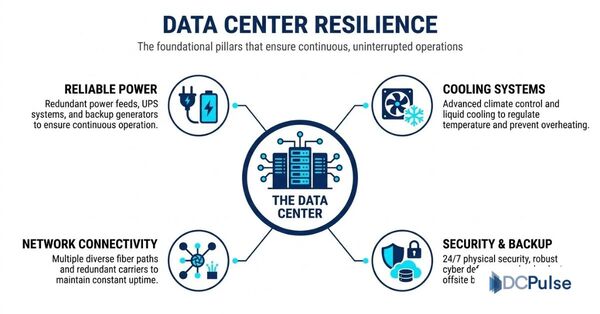
Traditional data center resilience has often been associated with equipment redundancy, backup power, multiple network paths, fault-tolerant architecture, and disaster recovery planning. These measures remain fundamental, but the growing complexity of digital infrastructure is exposing the limitations of treating resilience as a facility-level engineering exercise.
Modern data centers depend on interconnected systems that include electricity generation, transmission infrastructure, telecommunications networks, fuel availability, cooling resources, hardware supply chains, and operational personnel. A failure in one external dependency can affect services even when the data center itself remains operational.
Nordic infrastructure planning highlights the importance of considering these dependencies together. The region's emphasis on energy infrastructure, environmental conditions, and industrial integration provides a framework for understanding resilience as a system-wide capability rather than simply a collection of technical safeguards.
For data center operators, this perspective can influence site selection, capacity planning, facility design, operational risk assessments, and investment decisions.
Climate as an Infrastructure Advantage and Risk
The Nordic climate is frequently associated with data center development because cooler ambient conditions can support energy-efficient cooling strategies. Lower outdoor temperatures may create opportunities for free cooling and reduce reliance on mechanical refrigeration under suitable operating conditions.
However, climatic advantages do not eliminate operational risk. Weather variability, extreme conditions, moisture management, equipment protection, and changing environmental patterns still require careful engineering. Cooling systems must maintain reliable performance throughout the operating envelope, rather than relying exclusively on average climate conditions.
The wider lesson for infrastructure developers is the importance of climate-informed engineering. Site assessments need to evaluate both the potential efficiency benefits of local weather conditions and the environmental risks that could affect facility availability over its operational lifetime.
Climate suitability, therefore, becomes a long-term infrastructure consideration rather than merely an operating cost advantage.
Power Infrastructure Takes Center Stage
Electricity availability has become one of the most consequential factors in data center development. AI workloads, accelerated computing, and increasingly dense server deployments are raising power requirements, creating greater pressure on grid capacity, substations, transmission connections, and energy procurement strategies.
Nordic markets offer a useful context for examining the relationship between digital infrastructure investment and electricity systems. Access to energy resources alone does not guarantee that a proposed data center can secure the required connection capacity, delivery timelines, or long-term operational certainty.
Grid coordination is increasingly essential during the earliest stages of project planning. Developers must consider connection feasibility, infrastructure upgrade requirements, power delivery schedules, and the implications of competing demand from industrial and residential users.
A resilience-oriented strategy also requires consideration of what happens when the grid experiences disruption. Backup generation, battery energy storage, power distribution redundancy, fuel logistics, and tested recovery procedures remain critical elements of facility preparedness.
The Nordic lesson is not simply about securing electricity at a competitive cost. It is about treating power infrastructure as a strategic dependency that must be planned alongside computing capacity.
Waste Heat and Industrial Integration
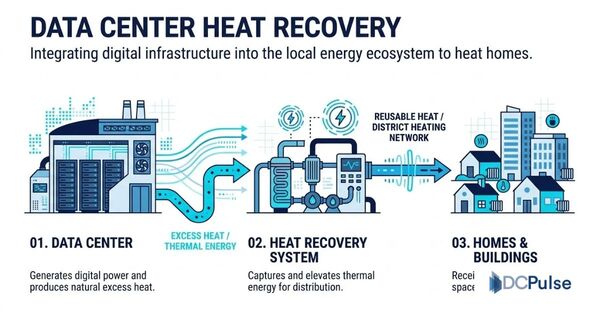
The Nordic region has also drawn attention to the potential for integrating data centers with district heating networks and other heat-consuming applications. Data centers produce substantial quantities of heat as a by-product of computing operations, creating opportunities for recovery and reuse where suitable infrastructure and demand exist.
Waste heat integration can connect digital infrastructure with local energy systems, potentially supporting heating applications and improving the overall utilization of energy entering a facility.
Such integration, however, requires more than installing heat recovery equipment. The availability of nearby heat demand, temperature requirements, infrastructure investment, commercial arrangements, seasonal demand patterns, and operational coordination all influence project feasibility.
For data center developers, heat reuse can become part of the wider site strategy. Facilities located near district heating networks, industrial consumers, or suitable developments may have opportunities to establish partnerships that extend their value beyond computing services.
The approach also encourages a different relationship between data centers and host communities, positioning infrastructure as a potential contributor to local energy systems rather than an isolated electricity consumer.
Security, Preparedness and Operational Discipline
Resilience also extends to physical security, cybersecurity, emergency preparedness, and the ability to maintain services during unexpected disruptions. Data centers supporting financial services, public administration, communications, healthcare, and cloud platforms occupy an increasingly important position within national and regional infrastructure.
The Nordic operating environment reinforces the importance of preparedness across multiple risk categories. Physical access controls, cybersecurity frameworks, incident response, redundancy testing, operational procedures, and coordination with external service providers all contribute to maintaining service continuity.
The distinction between designed resilience and demonstrated resilience is particularly important. Redundant equipment does not automatically guarantee recovery, especially when maintenance practices, configuration errors, shared dependencies, or human factors can undermine system performance.
Routine testing, realistic incident scenarios, recovery exercises, and documented procedures are therefore central to effective infrastructure operations. Resilience requires continuous validation rather than reliance on design assumptions established during construction.
Planning for Communities and Environmental Constraints
Data center projects are increasingly subject to scrutiny over energy use, land development, water consumption, environmental impacts, and their relationship with local infrastructure. Nordic experience provides a broader reminder that infrastructure planning must account for the surrounding region and its existing resource constraints.
Community engagement can influence project timelines, permitting, infrastructure upgrades, and the long-term relationship between operators and local stakeholders. Transparent communication about power requirements, cooling approaches, environmental impacts, employment, and infrastructure commitments can help establish a clearer basis for evaluating proposed developments.
Water management is another important consideration. Cooling system selection, local water availability, operating requirements, and environmental conditions should be assessed together. A cooling strategy that performs well technically may still face limitations depending on the site's resource availability and regulatory environment.
A Blueprint, Not a Universal Formula
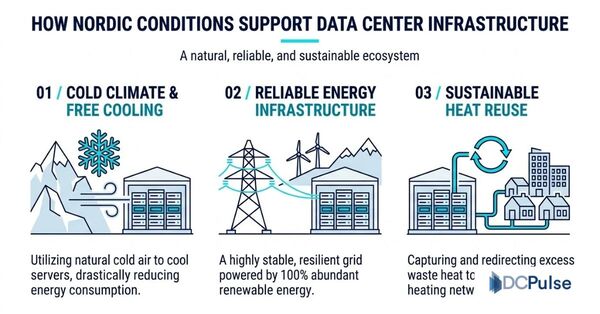
The Nordic experience should not be interpreted as a model that can be replicated identically across every market. Countries differ in climate, energy mix, grid capacity, regulatory structures, land availability, industrial infrastructure, and digital demand.
The most transferable principles are those that can be adapted to local conditions: early power coordination, climate-informed design, resource efficiency, external dependency mapping, operational testing, and integration with regional infrastructure where commercially and technically feasible.
For emerging data center markets, these considerations may be particularly relevant as large-scale AI campuses and cloud facilities move into areas where power networks and supporting infrastructure are still developing.
Resilience Becomes a Competitive Requirement
The next phase of data center development is likely to place greater emphasis on how effectively infrastructure manages interconnected risks. Efficiency, availability, scalability, sustainability, and security are increasingly linked rather than treated as separate objectives.
The Nordic perspective demonstrates why resilience cannot be reduced to backup generators, redundant cooling loops, or additional network paths. Reliable digital infrastructure depends on the strength of the systems surrounding the facility, the quality of planning decisions, and the ability of operators to adapt to changing conditions.
As AI and cloud infrastructure expand globally, resilience-oriented development could become an increasingly important differentiator for data center operators. The long-term value of a facility will depend not only on the computing capacity it delivers, but also on how reliably it can operate within an evolving energy, environmental, and infrastructure landscape.