Pranav Hotkar
For years, data center location strategy followed a familiar playbook: build close to users, near network hubs, with enough land to scale. Power was assumed to be available, a box to check, not a decision driver. That assumption no longer holds.
Today, energy has become the first and hardest constraint in data center planning. In many established markets, grid capacity is no longer guaranteed, interconnection timelines stretch into years, and securing large blocks of power can matter more than proximity to customers. The result is a quiet but fundamental shift: data centers are no longer choosing locations and then asking for power. They are choosing power first and letting geography follow.
This change isn’t theoretical. It is already influencing where new campuses are announced, how fast they can come online, and which regions are suddenly back on the map. From hyperscalers to colocation developers, energy availability is reshaping expansion plans, redefining “prime” markets, and forcing operators to rethink what an optimal data center location actually looks like.
That shift, from network-led siting to energy-led strategy, is now one of the most important forces shaping the next decade of data center growth.
Where Energy Limits Are Becoming the New Siting Constraint
As data center demand continues its upward trajectory, one resource has quietly become the gatekeeper of expansion: grid power availability. What used to be a background check, is there “some” electricity? has become the first filter in location strategy.
In many markets, utility interconnection queues, transmission bottlenecks, and generation capacity constraints now determine whether a site is viable at all. According to surveys, over 90% of senior data center professionals view grid constraints as the biggest obstacle to new builds, with interconnection wait times stretching four years or more in many regions.
Global Power Constraint Timeline (2014–2024) .jpg)
This isn’t unique to one region. In Europe, power supply shortages have slowed data center rollout, with new capacity growth constrained even as contracted demand remains high. In EMEA, only 850 megawatts of new power-enabled capacity came online in 2025, down from the previous year, not because demand softened, but because energy supply couldn’t keep up.
Global Interconnection Queue Map (2024-2025)
1.jpg)
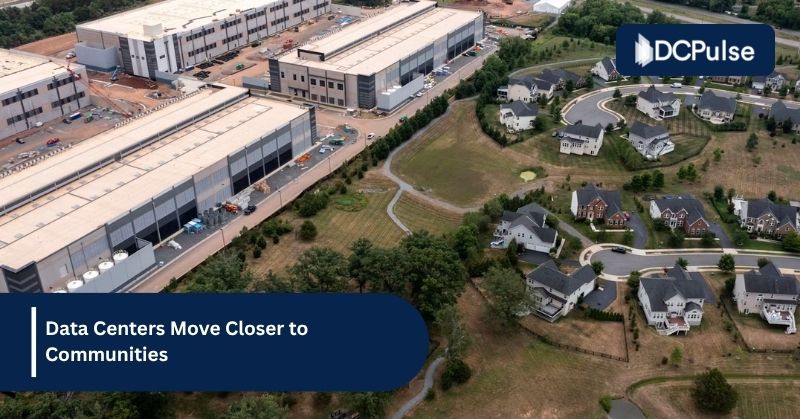
Grid congestion also reshapes site preference. In markets like London and Northern Virginia, exhaustion of available power has delayed new builds and even prompted local moratoria in some cases. Meanwhile, secondary regions with untapped grid capacity are attracting developers despite higher network latency or weaker connectivity, simply because power access beats all other constraints.
Power vs Traditional Site Priorities Chart (2014 vs. 2024)
.jpg)
Ultimately, what operators once considered a cost input, electricity pricing and generation mix, is now a strategic constraint that can accelerate or stall entire projects months or even years before construction begins.
Designing Data Centers Around Power Reality
As energy constraints harden into long-term realities, data center innovation is shifting toward a simple premise, design within power limits, not in anticipation of future availability. Instead of building for maximum theoretical capacity upfront, operators are increasingly defining a fixed energy envelope first and engineering everything inside it. Modular construction, phased commissioning, and flexible density planning now allow capacity to scale in step with actual power delivery rather than optimistic grid timelines.
Modular Capacity Growth Curve (100MW Context)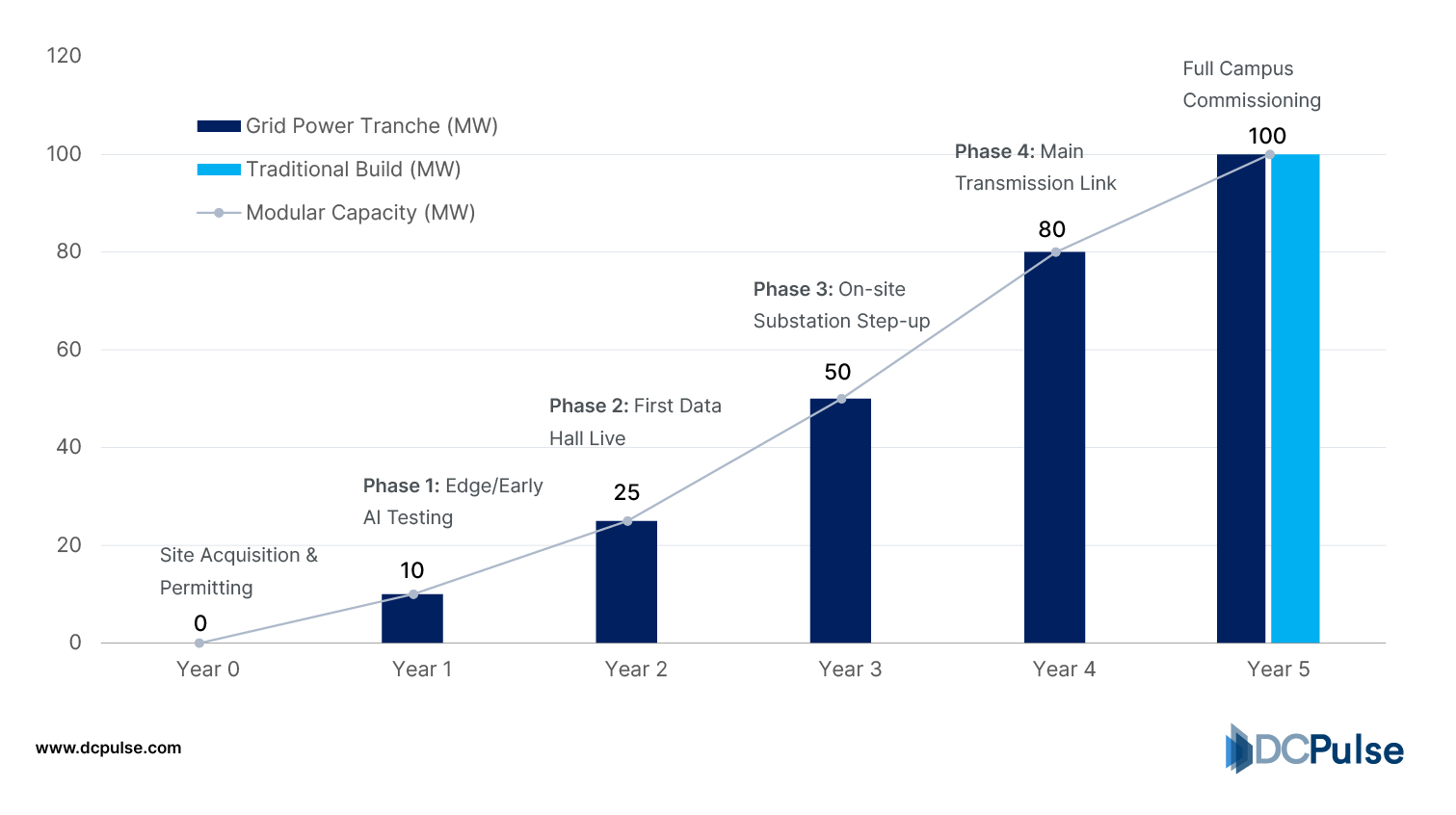
At the infrastructure level, on-site generation and hybrid energy models are moving from backup roles into core planning tools. Hyperscalers and large colocation providers are pairing grid power with renewable PPAs, gas-based generation, and battery storage to reduce dependence on immediate grid upgrades.
The International Energy Agency notes that behind-the-meter generation and storage are becoming essential for large energy consumers as grid congestion increases globally. For data centers, this approach doesn’t replace the grid, it reshapes deployment timelines.
Efficiency-led design is also reshaping location feasibility. Higher rack densities, liquid cooling, and workload-aware power management allow operators to extract more compute per megawatt.
Uptime Institute research shows that advanced cooling and power optimization can reduce energy consumption per unit of compute by double-digit percentages. That efficiency can make power-constrained regions viable again.
Finally, workload flexibility is loosening the tie between compute and geography. Energy-aware workload placement allows non-latency-sensitive tasks to run where power is available, with networks optimized afterward. Researchers highlight this shift as a growing lever for balancing cost, resilience, and scale.
Latency vs Power Trade-Off Chart (2025)
.jpg)
How Power Realities Are Reshaping Where Data Centers Get Built
The shift from land and connectivity to power availability isn’t hypothetical, it’s visibly shaping real projects around the world. In many traditional hubs, grid constraints are already slowing expansion and forcing operators to rethink long-held location assumptions.
A report shows that power supply issues in the EMEA region have slowed data center rollout, with new capacity additions falling in 2025 not because of falling demand, but due to grid limitations.
Timeline of Power-Limited Market Decisions (2019–2025)
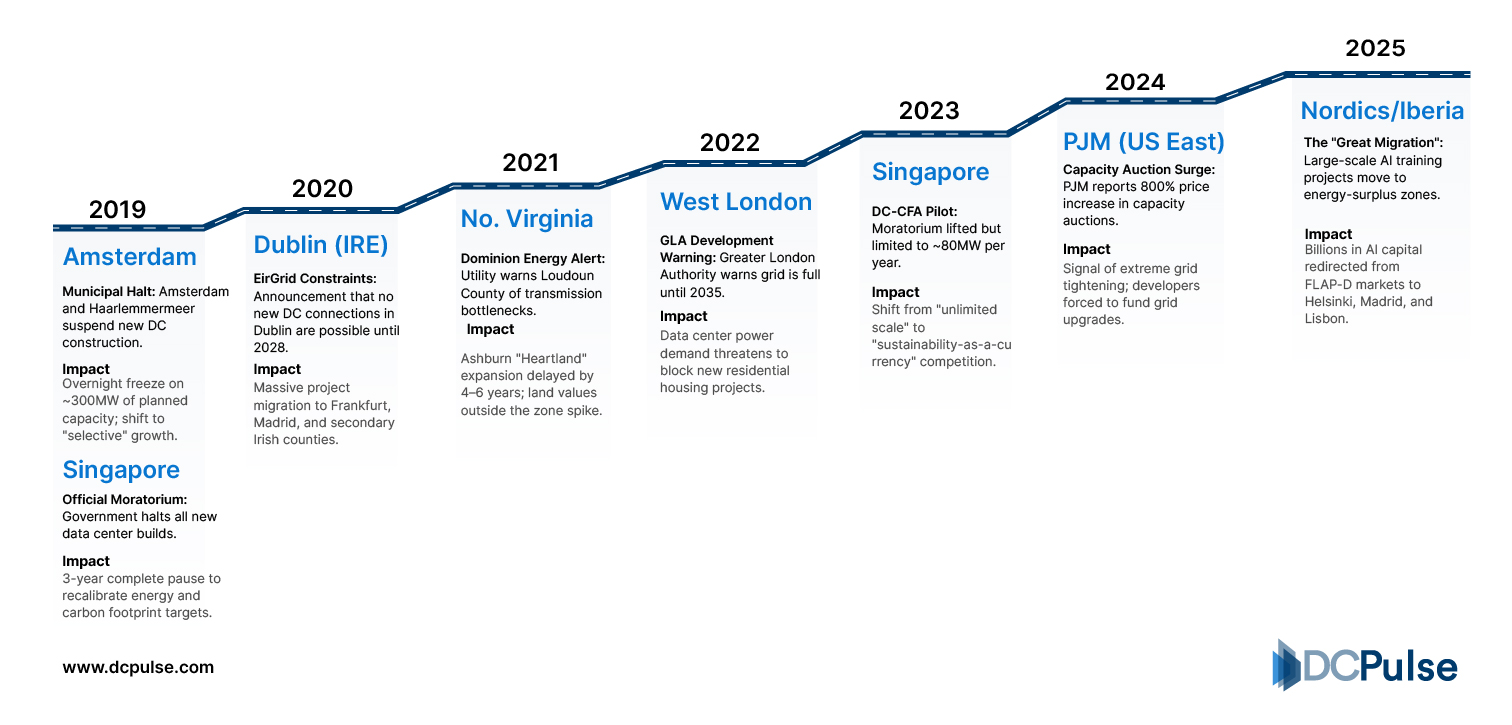
Developers are reacting. Hyperscale cloud providers and large colocation firms are increasingly prioritizing markets where power timelines align with build plans. In constrained metros like London and Northern Virginia, grid upgrades and interconnection queue backlogs, sometimes stretching three to ten years, now factor into site feasibility studies, not just engineering plans. Secondary markets with comparatively abundant power, such as Richmond (US), parts of Latin America, and emerging Asia-Pacific hubs, are gaining traction because they allow operators to secure energy faster and cheaper.
Meanwhile, shifts are visible upstream. End users are preleasing space years ahead in power-tight hubs to lock capacity before infrastructure can catch up, and operators are investing in on-site generation partnerships to shorten delivery timelines.
These moves aren’t isolated; they’re tactical responses to a global phenomenon, power availability is redefining data center location strategy in practice, not just in theory.
Location Strategy in an Energy-Constrained World
Energy constraints are no longer a temporary planning headache; they are a structural feature of data center expansion. Over the next decade, successful location strategies will be defined less by proximity to users and more by access to scalable, reliable power pathways. For developers and operators, this means treating energy availability as a first-order design input, not a late-stage procurement task.
One clear takeaway is that “prime markets” are being redefined. Established hubs will continue to matter, but only where grid upgrades, long-term utility commitments, or on-site generation can support growth.
At the same time, secondary and emerging regions with available capacity are becoming strategically valuable, even if they require more sophisticated network planning or workload placement strategies.
Planning models are also changing. Capacity must be phased, flexible, and resilient to uncertainty in grid delivery timelines. Operators that align design, power sourcing, and workload strategy early are better positioned to bring sites online faster and avoid stranded capital.
Ultimately, energy constraints are not slowing the data center industry, they are reshaping how and where it grows. The winners will be those who adapt location strategy to this new reality, rather than waiting for the grid to catch up.