DCPulse
T-Mobile US reduced its workforce by 4,671 full-time equivalent positions during the first half of 2026, as parent company Deutsche Telekom continues a broader workforce transformation focused on simplifying operations and supporting modernization across the US business.
The reduction brought T-Mobile US’ workforce to 65,365 employees at the end of June, down from 70,036 at the end of 2025. Deutsche Telekom said the 6.7% decline was primarily attributable to its 2025–2026 Workforce Transformation program.
The restructuring comes as T-Mobile continues expanding its wireless, broadband, fiber, and digital infrastructure footprint. The company has also been integrating assets from recent acquisitions while investing in network capacity and technology.
For the data center and digital infrastructure industry, the workforce reduction provides a window into how major telecommunications operators are reorganizing around increasingly software-driven networks, automation, fiber infrastructure, and digital services.
Workforce Transformation Targets Organizational Complexity
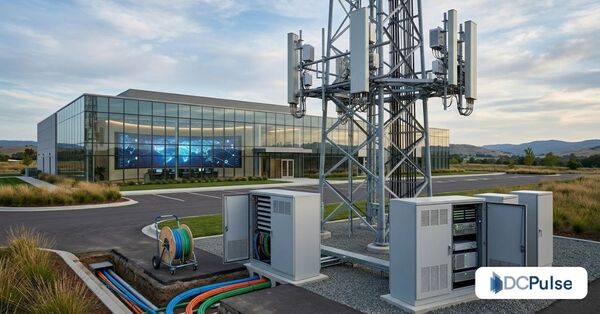
Deutsche Telekom launched the workforce transformation as an effort to streamline operations, centralize leadership and teams, reduce organizational layers, and eliminate duplicated roles.
The changes are taking place alongside T-Mobile US' continued expansion into adjacent connectivity markets. Recent acquisitions have increased the scale and complexity of the company's infrastructure operations, particularly across wireless and fiber networks.
The US business has added customers and assets through transactions, including the acquisition of UScellular and fiber-related acquisitions. Deutsche Telekom's first-half report also notes agreements involving i3 Broadband, GoNetspeed, and Greenlight Networks, subject to regulatory and closing conditions.
That combination creates a different infrastructure challenge from traditional mobile-network expansion. T-Mobile increasingly operates across wireless connectivity, fixed broadband, fiber, and connected-device services, requiring greater coordination between physical infrastructure and digital platforms.
Network Modernization Remains a Core Priority
The workforce reduction does not represent a retreat from infrastructure investment.
T-Mobile continues to maintain and expand the networks that support mobile connectivity, broadband, and enterprise services. The company's current strategy involves allocating resources toward areas considered important to customer growth and network development.
The distinction is important for data centers. Telecom operators are major users and providers of digital infrastructure, with data centers supporting network applications, cloud platforms, enterprise services, content delivery, and other workloads.
As telecommunications networks become increasingly software-defined, some traditional operational functions can be consolidated or automated. That can change the balance between physical network deployment, centralized operations, and software-based management.
The result is a workforce model that may place greater emphasis on specialized technology skills while reducing organizational duplication.
Implications for Data Center Infrastructure
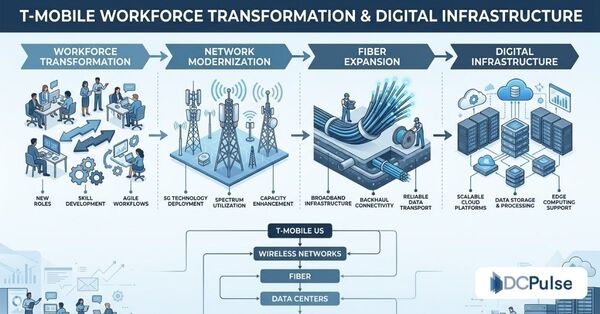
T-Mobile's restructuring is relevant to data centers because telecom networks and data center infrastructure are becoming increasingly interconnected.
Mobile traffic, fixed broadband services, enterprise connectivity, and cloud applications all depend on underlying computing and network infrastructure. Data centers provide locations for processing, routing, storing, and exchanging digital workloads that ultimately reach customers through telecommunications networks.
T-Mobile's expansion into fiber broadband further strengthens this relationship.
The company's US business reported 34.7 million postpaid accounts at the end of June 2026, up from 34.2 million at the end of 2025. Deutsche Telekom also noted that fiber account additions contributed to customer growth following acquisitions.
Growing connectivity services can increase the importance of network capacity, edge infrastructure, and data processing capabilities. The exact effect on T-Mobile's data center footprint, however, cannot be determined from the workforce figures alone.
Fiber Expansion Adds Infrastructure Complexity
Fiber is becoming an increasingly important component of T-Mobile's broader connectivity strategy.
The company has expanded its fiber presence through acquisitions, including Metronet and Lumos, while Deutsche Telekom has disclosed additional proposed transactions involving fiber operators.
Fiber networks can complement wireless infrastructure by providing high-capacity fixed connectivity and backhaul. They also create additional requirements for network operations, provisioning, service management, and infrastructure monitoring.
For data centers, the expansion of fiber connectivity can strengthen the ecosystem surrounding facilities by increasing the availability of high-capacity links between customers, network nodes, and computing infrastructure.
The integration of wireless and fiber assets may therefore influence how telecom companies design their network architecture and where computing resources are positioned.
IT Reorganization Points to More Digital Operations
T-Mobile has also made changes within its information technology organization during 2026.
In March, the company confirmed that it was further aligning its IT organization to support future growth and innovation while eliminating some roles and continuing to invest and hire in other areas.
The development illustrates a broader technology-industry pattern in which organizations are attempting to simplify internal structures while directing resources toward newer technology platforms.
For digital infrastructure, this can mean greater emphasis on automation, centralized systems, cloud technologies, cybersecurity, data analytics, and software-based network management.
Those priorities can influence the type of infrastructure telecom operators require, even when the relationship between individual workforce decisions and data center demand is not directly measurable.
Acquisition Integration Is Another Factor
T-Mobile's workforce transformation is also occurring during a period of integration following acquisitions.
Deutsche Telekom reported that integration expenses associated with the US cellular acquisition affected the group's financial results, while accelerated depreciation of certain assets was linked to integration measures in the US business.
Integrating acquired networks and systems can require substantial coordination across technology platforms, operational processes, and infrastructure.
The consolidation of overlapping functions can therefore be part of an effort to create a more unified operating model.
For data center infrastructure providers, telecom consolidation can have implications for connectivity requirements, network interconnection, and the systems supporting enterprise and consumer services.
Data Center Operators Watch Telecom Modernization
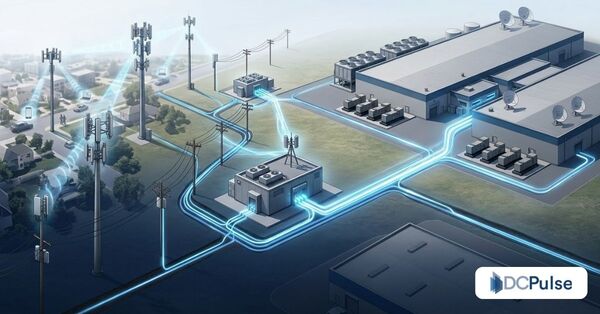
Telecommunications companies remain important participants in the wider digital infrastructure market.
Their networks connect data centers to businesses and consumers, while their fiber assets can provide critical transport between facilities and end users. Mobile and broadband growth can also increase the volume of data moving through the digital ecosystem.
T-Mobile's restructuring therefore represents more than a workforce story.
The reduction in headcount is occurring alongside continued investment in connectivity and infrastructure, demonstrating how modernization can involve both expansion of physical networks and restructuring of the organizations operating them.
For data center developers and operators, the relevant question is not simply how many employees a telecom company has, but how efficiently it can operate and expand the infrastructure supporting digital services.
What Comes Next for T-Mobile's Digital Infrastructure
Deutsche Telekom's first-half results show that the workforce transformation remains a significant factor in the US segment's organizational changes.
At the same time, T-Mobile US continues to expand its customer base and pursue additional fiber opportunities. The company's current strategy therefore combines organizational simplification with continued development of connectivity infrastructure.
The longer-term impact on data centers will depend on how T-Mobile develops its network architecture, fiber footprint, computing requirements, and digital service portfolio.
For the broader digital infrastructure market, the restructuring highlights an important transition. Telecom operators are increasingly managing large, interconnected technology environments in which wireless networks, fiber, cloud services, computing platforms, and data centers operate as parts of a single digital ecosystem.
T-Mobile's 2026 workforce transformation shows that modernization is not limited to deploying new infrastructure. It can also involve restructuring the organizations responsible for operating that infrastructure, consolidating overlapping capabilities, and directing resources toward the technologies expected to support the next stage of connectivity growth.