DCPulse
Telesat is expanding the planned scale of its Lightspeed low Earth orbit (LEO) satellite network after securing a major Canadian government contract for military communications across the Arctic. The agreement is expected to increase the constellation from 156 to 225 satellites, strengthening the infrastructure planned for both defense and commercial connectivity.
The contract with Canada’s Defence Investment Agency covers secure military Ka-band connectivity for the Canadian Armed Forces under the Enhanced Satellite Communications Project – Polar (ESCP-P). The initial agreement is valued at C$2.3 billion, while two five-year options bring the potential value to C$2.7 billion, equivalent to approximately US$1.93 billion based on the figures reported for the agreement.
Service is expected to begin in 2028, in line with Telesat’s previously stated target for global Lightspeed service. The additional satellites will include both commercial and Mil-Ka capacity, giving the expanded network a broader role across communications infrastructure.
Arctic Connectivity Drives Constellation Expansion
The Canadian contract focuses on connectivity across the country’s Arctic region, covering latitudes from 65 to 90 degrees North. The requirement highlights the role of LEO satellite networks in areas where conventional terrestrial communications infrastructure can be difficult to deploy or extend.
Telesat’s Lightspeed architecture is intended to provide low-latency connectivity through a large LEO constellation. Under the new agreement, the additional satellites will increase the overall scale of the network while incorporating dedicated military Ka-band capabilities.
The Canadian government has described the project as supporting secure and reliable communications for Canadian Armed Forces operations. The broader ESCP-P program also includes ground infrastructure and other satellite communications capabilities.
For digital infrastructure providers, the development demonstrates how satellite networks can form another layer of connectivity alongside terrestrial fiber, cellular networks, and conventional satellite systems.
Network Scale Moves Higher

The addition of 69 satellites represents a significant change to the original Lightspeed architecture. Telesat says the expansion increases the constellation from 156 to 225 satellites, corresponding to a 44% increase in network scale and capacity compared with its previous plan.
The additional spacecraft are expected to be built by MDA Space at its manufacturing facility in Montreal. Telesat has also stated that launches will use SpaceX Falcon 9 rockets, with launch capacity already secured for some of the additional satellites and another launch subject to completion of a launch services agreement.
The larger constellation could provide Telesat with additional infrastructure for serving different classes of customers. The satellites are being configured with both commercial and military communications capabilities, linking the defense requirement to the broader development of the Lightspeed platform.
That approach is relevant to the digital infrastructure sector because satellite networks increasingly operate as part of interconnected communications environments rather than as isolated connectivity systems.
Ground Infrastructure Remains Critical
Satellite capacity alone does not provide an end-to-end communications service. The ESCP-P agreement also includes network integration requirements covering user terminals, ground and control infrastructure, and training and support services, although those elements are covered through a separate agreement between the Defence Investment Agency and Telesat.
The ground segment is particularly important when satellite connectivity needs to interact with terrestrial networks and operational systems. Traffic ultimately has to move between satellite links and the wider communications infrastructure supporting users, applications, and data.
For data center operators, this creates another point of intersection between satellite and terrestrial infrastructure. Data centers can serve as network aggregation points, cloud access locations, and interconnection environments, while satellite systems can extend connectivity to regions where terrestrial infrastructure has limited reach.
The exact architecture will depend on how individual services and networks are deployed, but the broader trend points toward greater integration between space-based and ground-based connectivity.
Implications for Data Center Connectivity

The Telesat expansion does not represent a conventional data center investment, but its infrastructure could have implications for the wider digital ecosystem supporting distributed computing.
Cloud platforms and enterprise applications increasingly depend on connectivity across geographically dispersed locations. Remote industrial facilities, government installations, and other locations outside major metropolitan networks may require communications paths that cannot rely solely on terrestrial fiber.
LEO satellite networks can provide an additional connectivity layer in such environments. Their role can become particularly relevant where geographic conditions, distance, or limited terrestrial infrastructure create connectivity challenges.
For data center operators, satellite connectivity could therefore complement existing network strategies rather than replace terrestrial connectivity. The practical value will depend on latency, capacity, availability, network integration, and the requirements of individual workloads.
Sovereign Infrastructure Gains Importance
The Canadian contract also highlights the growing importance of sovereign communications infrastructure.
Canada’s government has positioned the ESCP-P program around secure communications capabilities for operations in the Arctic. Telesat’s role in the Mil-Ka portion of the program provides the company with a long-term government customer while expanding a network that is also intended to support commercial users.
Sovereign infrastructure considerations are becoming increasingly relevant across digital infrastructure. Governments and critical industries are examining how communications, cloud computing, data storage, and networking can remain resilient and under appropriate national control.
Satellite systems can contribute to that strategy by providing connectivity that is geographically independent of individual terrestrial routes.
The Canadian program also includes a separate UHF and X-band component, with MDA Space serving as prime contractor and Telesat acting as a key subcontractor and systems integrator.
A Larger Platform for Commercial Connectivity
The defense contract also changes the commercial context surrounding Lightspeed. Telesat has said the expansion increases the commercial potential of the network, with the additional satellites carrying both military and commercial capacity.
A larger constellation gives the company a broader infrastructure platform from which to develop services across different markets. Defense requirements provide an important anchor, while commercial applications can potentially use the same underlying satellite architecture.
For the data center and cloud sectors, the significance lies in the continued convergence of communications infrastructure. Computing resources are becoming increasingly distributed, and connectivity between those resources is becoming an essential part of infrastructure planning.
Satellite connectivity is one component of that broader network environment.
Manufacturing and Deployment Enter a Larger Phase
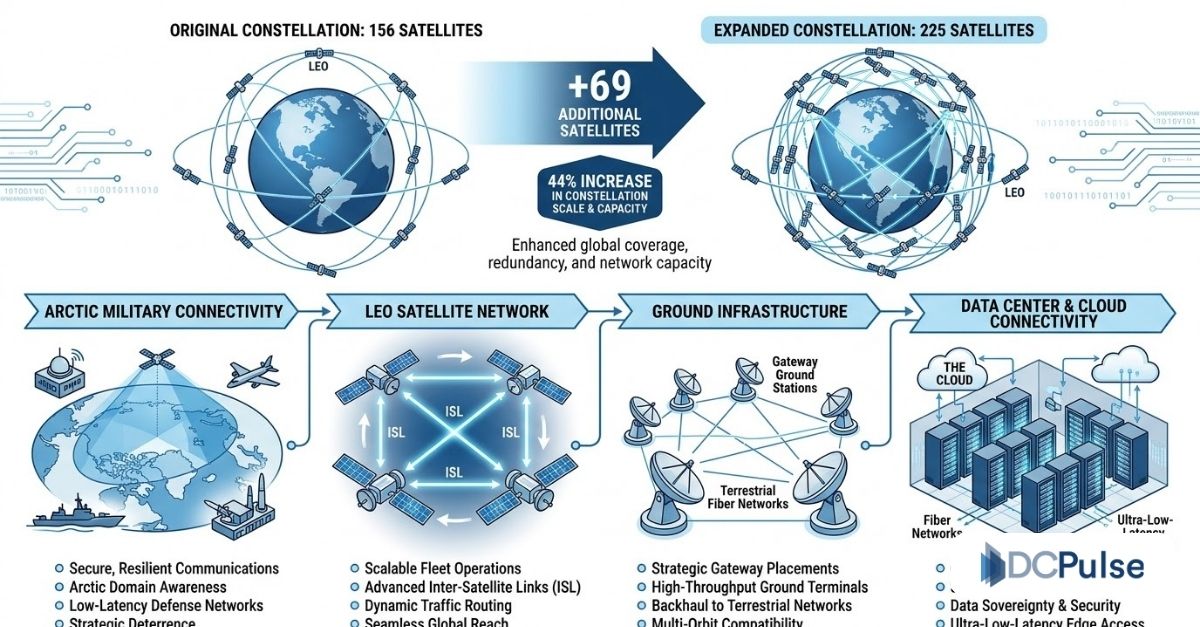
The expansion also increases the physical infrastructure required to bring Lightspeed into operation. Telesat says the 69 additional satellites will be manufactured in Montreal, with milestone-based government payments supporting the expansion beginning in the third quarter of 2026.
The deployment schedule will remain an important factor as the expanded constellation moves toward service. Telesat continues to target the first quarter of 2028 for global Lightspeed service, while the Canadian military service is expected to begin in 2028.
The additional satellites therefore represent more than an increase in orbital capacity. They require manufacturing, launch, ground infrastructure, network management, and operational coordination across multiple parts of the digital communications ecosystem.
Satellite Networks Become Part of Digital Infrastructure
Telesat’s Arctic contract illustrates how satellite communications are increasingly being considered alongside terrestrial infrastructure when governments and enterprises plan resilient connectivity.
The expanded Lightspeed constellation will be primarily associated with satellite communications, but its eventual role can extend into the wider digital infrastructure environment. Connectivity is becoming an increasingly important link between data centers, cloud platforms, remote locations, government systems, and distributed computing resources.
The immediate priority for Telesat is delivering the expanded constellation and the required military connectivity. For the broader infrastructure market, the development provides another example of how satellite networks are becoming integrated into a more diverse connectivity landscape.
As data-intensive workloads continue to spread beyond traditional technology hubs, the ability to connect locations through multiple infrastructure layers could become increasingly important. Telesat’s expanded Lightspeed network places LEO connectivity firmly within that evolving infrastructure picture.