DCPulse
The U.S. Federal Communications Commission has authorised Xona Space Systems to move forward with its planned Pulsar positioning, navigation, and timing (PNT) constellation, a development that could add a new layer of satellite-based timing and positioning infrastructure for industries that depend on resilient digital systems.
The FCC action, dated July 31, 2026, granted Xona’s application in part and deferred other elements, with conditions. The authorisation covers a planned non-geostationary satellite system of up to 258 low Earth orbit satellites operating in radionavigation, space operation, and inter-satellite services.
Xona’s Pulsar architecture is planned around satellites operating at approximately 1,080 kilometres above Earth. The system is intended to provide positioning, navigation, and timing services using signals in a spectrum that includes the L-band frequencies used by established satellite navigation systems.
For the data centre industry, the significance extends beyond navigation. Precise and reliable timing is embedded in many of the systems that coordinate digital infrastructure, telecommunications, financial networks, cloud platforms, and industrial operations.

Data centres are generally associated with compute, storage, power, and cooling, but timing is another important infrastructure dependency.
Modern digital networks use highly synchronised clocks to coordinate communications, monitor systems, timestamp transactions, and support distributed applications. Telecom networks, financial services, industrial control systems, and other critical infrastructure can also depend on accurate timing references.
Global Navigation Satellite Systems such as GPS can provide an important external timing reference. Receivers can use satellite signals to synchronise local clocks even when those systems are physically separated from terrestrial network infrastructure.
That dependency also creates a resilience consideration. A disruption affecting satellite navigation signals can potentially affect organisations that rely on them for positioning or timing. The FCC itself has examined the growing role of alternative PNT technologies, including commercial low-Earth-orbit systems. Its 2025 report identified Xona as one of the companies developing LEO-based PNT infrastructure.
Xona is positioning Pulsar as an additional source of PNT rather than simply another satellite broadband network. Its system uses a constellation architecture designed specifically around navigation and timing.
LEO architecture changes the PNT model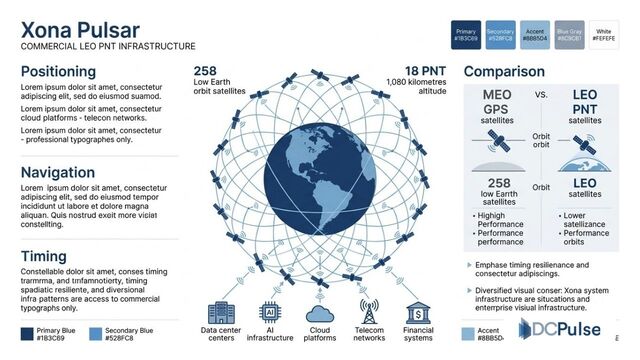
Traditional global navigation systems such as GPS operate satellites in medium Earth orbit. Pulsar instead uses a much larger number of satellites in low Earth orbit.
The planned 258-satellite system is structured across 18 orbital planes. ITU documentation describing the Xona PULSAR system identifies 12 inclined planes containing 16 satellites each and six polar planes containing 11 satellites each. The planned nominal orbital altitude is 1,080 kilometres.
The lower orbit changes the geometry and signal environment experienced by receivers on the ground. Xona says Pulsar is designed to provide stronger signals and centimetre-level positioning while also incorporating authentication capabilities.
For data centre operators, however, the most relevant question is not whether Pulsar replaces GPS. Its near-term value could instead come from diversification.
A facility that uses multiple timing sources can potentially reduce dependence on a single external system. Such an approach can be relevant to hyperscale campuses, telecommunications facilities, financial infrastructure, and other sites where synchronisation forms part of operational resilience.
Data centres could become an important PNT application.
Large data centres increasingly operate as components of geographically distributed computing platforms. Cloud services can span multiple facilities and regions, while AI infrastructure depends on high-speed networking between compute clusters and supporting systems.
Accurate timing helps these environments coordinate events across distributed infrastructure. Network monitoring, security systems, telecommunications equipment, and other digital services can also use precise time references.
Pulsar does not directly provide power, connectivity, or compute capacity to a data centre. Its potential role is more foundational: providing another external timing and positioning signal that infrastructure operators could incorporate into resilience architectures.
That distinction is important. The FCC authorisation does not mean data centres will automatically adopt Pulsar, nor does it establish a requirement for facilities to use the service. Receiver compatibility, commercial availability, integration costs, and operational validation will determine whether the technology gains traction in the sector.
Resilience becomes more important as infrastructure becomes distributed
The growth of AI and cloud infrastructure is increasing the geographic and technical complexity of digital systems.
AI clusters can involve large numbers of servers, high-speed networks, and multiple supporting facilities. Cloud platforms similarly depend on interconnected infrastructure distributed across regions. Telecommunications networks provide another layer connecting these systems to users and other facilities.
This broader infrastructure environment increases the importance of independent sources of synchronisation.
A diversified PNT architecture could give operators another option if GPS or another GNSS source becomes unavailable, degraded, or unreliable. The FCC has highlighted the broader need for resilient PNT capabilities, while commercial LEO providers are attempting to build alternatives or complements to traditional GNSS infrastructure.
The value proposition is therefore closely connected to redundancy. In the same way that data centres deploy redundant power paths, network connections, and cooling systems, external timing sources can form part of a broader resilience strategy.
Spectrum coordination remains critical

The FCC decision also highlights the regulatory complexity surrounding commercial PNT infrastructure.
Xona’s original filing sought authority for up to 258 LEO satellites and operation across several frequency bands. The FCC's July action granted the application in part and deferred portions of the request, with conditions.
That regulatory framework matters because navigation signals operate alongside other users of valuable radio spectrum. Any new commercial PNT network must demonstrate that its transmissions can coexist with existing systems.
Xona has already used its Pulsar-0 satellite to demonstrate its navigation technology. The company now describes the FCC authorisation as a step toward scaling the system from demonstration into a larger operational constellation.
The move also follows growing interest in commercial alternatives and complementary systems for PNT. Xona is not alone in pursuing this market, with other companies developing LEO-based navigation technologies and services.
Manufacturing and satellite infrastructure add another layer
The planned constellation will also create demand for satellite manufacturing, launch services, ground infrastructure, and network operations.
Xona has said it is scaling satellite production at its Burlingame, California, facility and plans to deploy the 258-satellite constellation over the coming years. The company announced a $170 million Series C financing round in 2026 to support deployment and manufacturing expansion.
For the broader digital infrastructure market, this represents another example of how data centre resilience increasingly intersects with infrastructure beyond the physical data centre campus.
Cloud computing, telecommunications, and AI systems rely on an expanding collection of external infrastructure, including fibre networks, electrical grids, satellite systems, and timing services. PNT is becoming part of that wider infrastructure ecosystem.
The next test will be operational adoption
The FCC authorisation removes a major regulatory barrier, but the commercial impact of Pulsar will depend on deployment and adoption.
A full constellation must be manufactured, launched, and operated while maintaining the required spectrum and orbital conditions. At the same time, equipment manufacturers and infrastructure operators would need to determine where the service provides enough value to justify integration.
For data centres, the most immediate opportunity is likely to be as an additional timing and positioning source rather than a wholesale replacement for GPS.
As AI facilities, cloud regions, and communications networks become increasingly distributed, resilience is becoming a central infrastructure consideration. Xona’s planned 258-satellite Pulsar network adds another potential component to that resilience stack, bringing commercial LEO PNT closer to becoming an operational infrastructure layer.
The broader significance is that satellite infrastructure is moving beyond connectivity and into the timing and positioning systems that underpin modern digital networks. If Pulsar reaches its planned scale and achieves commercial adoption, data centres and other critical digital facilities could become part of a much wider ecosystem of users relying on diversified space-based infrastructure.