Pranav Hotkar
AI doesn’t fail in the cloud; it fails when systems can’t respond in time.
A self-driving vehicle cannot rely on a distant data center to process every decision on the road. An automated factory line cannot afford delays when detecting faults or adjusting operations. In these environments, even small delays in data processing can disrupt outcomes, making latency a practical limitation rather than a theoretical one.
For the past decade, AI development has been centered in large, centralized data centers optimized for scale and training workloads. But as AI increasingly shifts toward real-time inference, powering applications in transportation, manufacturing, telecom, and smart infrastructure, that centralized model is being pushed to its limits. Network latency, bandwidth costs, and dependency on continuous connectivity introduce constraints that are difficult to ignore at scale.
Edge AI data centers are emerging as a response to this shift, bringing compute resources closer to where data is generated and decisions need to be made.
Because in real-time systems, the value of AI is determined not just by accuracy but by how quickly it can act.
How is AI infrastructure shifting from centralized clouds to the edge?
For most of the past decade, AI infrastructure has been centered in hyperscale data centers, optimized for large-scale training where latency is secondary. That model is now being tested as AI shifts toward inference, where systems must respond in near real time.
Inference workloads are increasingly tied to where data is generated, industrial systems, telecom networks, and connected devices. In these environments, latency directly affects performance. Industry surveys show that 90% of enterprises require latency of 10 ms or less, with many targeting 5 ms for real-time applications.
The limitation is structural. According to Cisco, routing workloads through centralized data centers typically results in 100-200 ms latency, while edge architectures reduce this to 1-30 ms.
Edge computing addresses this by moving compute closer to the source of data. This shift can reduce latency from 50-150 ms in cloud environments to as low as 5-20 ms at the edge, while also lowering network traffic.
Latency comparison - Cloud vs Edge ranges (2026)
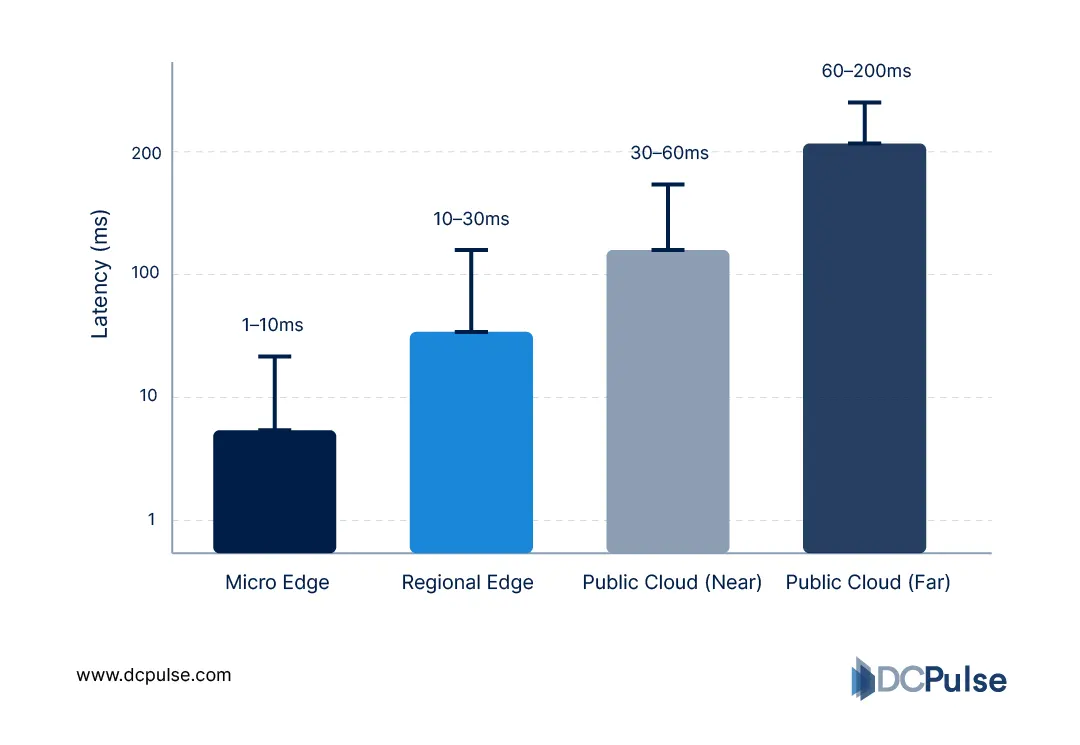
Rather than replacing hyperscale infrastructure, edge data centers extend it, deploying smaller, distributed nodes closer to users and devices. As Cisco notes, this architectural shift is driven by the need to meet modern application performance requirements that centralized systems alone cannot satisfy.
This is not a theoretical transition. It reflects how AI is now being deployed, where speed, locality, and reliability define value as much as compute scale.
What innovations are making edge AI data centers viable at scale?
Edge AI data centers were historically limited by deployment speed, power density, and operational complexity. That is changing as infrastructure design itself becomes modular and pre-integrated.
Prefabricated modular data centers are a key enabler. These systems are factory-built, pre-tested, and rapidly deployable, significantly reducing on-site construction time and complexity. According to Vertiv, prefabricated modular designs enable faster deployment, lower risk, and improved cost predictability compared to traditional builds.
Deployment time comparison
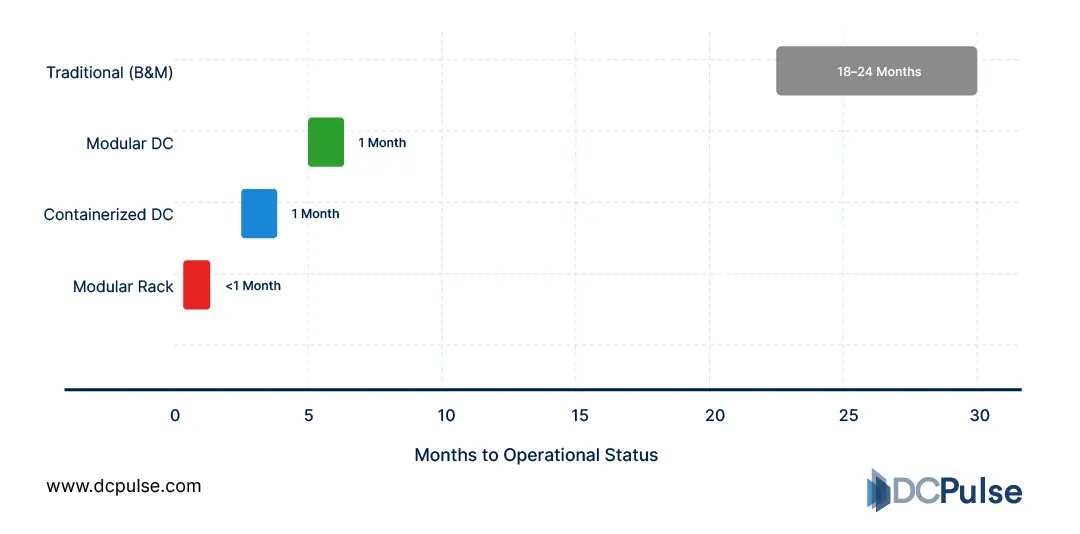
This modular approach is also being adapted specifically for AI workloads. Schneider Electric highlights that modular AI data centers are designed to handle high-density compute and advanced cooling requirements while enabling faster scaling in constrained environments.
At the architecture level, edge AI is being shaped by a broader shift toward “edge intelligence,” where compute is distributed closer to data sources to handle massive real-time data generation. Research shows this reduces latency from 50-200 ms in cloud environments to as low as 1–10 ms at the edge, depending on proximity and network conditions.
Latency Comparison: Cloud vs. Edge Computing
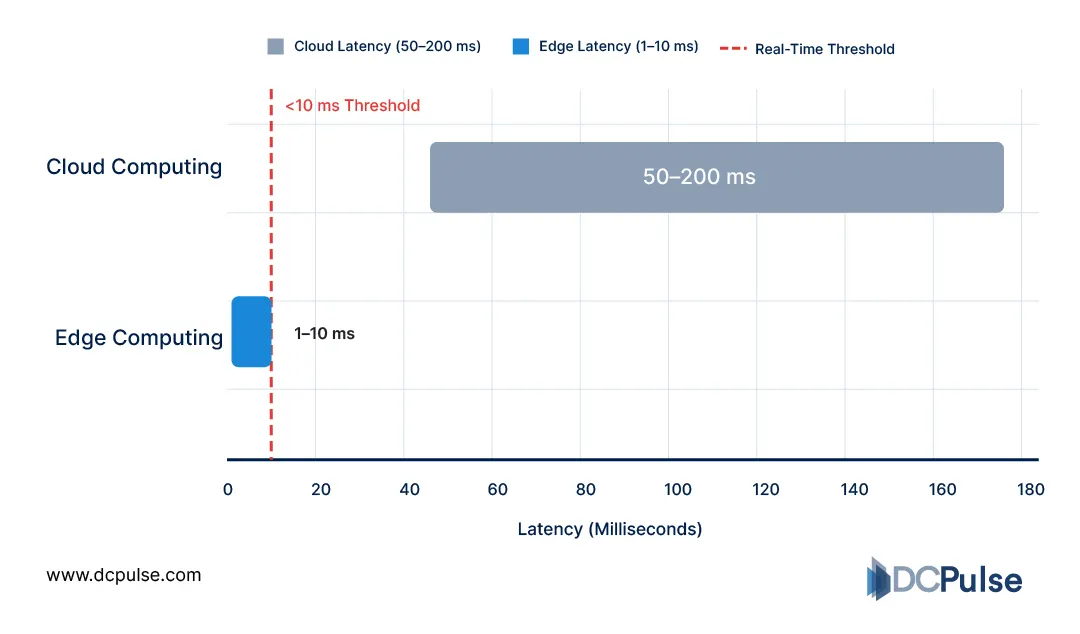
Edge deployment is also aligning with network topology evolution. Industry architecture models show far edge latency at ~1-5 ms, metro edge at 5-50 ms, and centralized cloud beyond that range, reinforcing the need for distributed compute layers.
Together, these innovations, modular infrastructure, AI-optimized design, and distributed compute frameworks are turning edge deployments from custom-built experiments into repeatable, scalable systems.
Who is shaping the edge AI data center ecosystem today?
The expansion of edge AI infrastructure is being driven by coordinated moves from hyperscalers and telecom operators, bringing compute closer to users through integrated network deployments.
Amazon Web Services has taken a leading role with Wavelength, embedding compute and storage directly inside telecom networks. In partnership with Verizon, this model places AWS infrastructure at the edge of 5G networks, enabling applications to run with single-digit millisecond latency. These deployments are already live across multiple U.S. metro areas, reducing the distance and network hops between users and applications.
This approach is being mirrored across the industry. Microsoft has introduced Azure Edge Zones in collaboration with AT&T, integrating cloud services directly into carrier data centers to support low-latency applications such as gaming and urban infrastructure.
At the network layer, telecom-led edge platforms are becoming multi-cloud. Verizon’s 5G Edge now integrates both AWS and Microsoft environments, enabling real-time applications like machine learning inference and industrial automation to run closer to end users.
Evolution of Edge Computing (2019–2026)
.webp)
These moves reflect a clear industry direction: edge AI is not being built in isolation, but through tightly coupled cloud–telecom ecosystems designed to deliver low-latency intelligence at scale.
What does the future of edge AI data centers look like, and what should operators prioritize?
Edge AI data centers are not replacing hyperscale infrastructure; they are becoming a permanent extension of it. As AI shifts toward inference-driven workloads, infrastructure will increasingly be designed around where decisions need to happen, not just where compute is most efficient.
This shift is already visible across enterprise and telecom environments, where more data is being processed closer to its source. At the same time, latency requirements are becoming a defining constraint, with real-time applications demanding near-instant response.
This creates new pressure on infrastructure design. Edge environments operate within tighter power, space, and operational limits, making efficiency in cooling, hardware, and energy use critical to scalability.
The strategic takeaway is clear: organizations must move beyond centralized thinking and design for distributed intelligence. That means building architectures that are latency-aware, operationally flexible, and capable of scaling across both cloud and edge environments.
Because in the next phase of AI, performance will not be defined by compute alone but by how effectively it is positioned.