DCPulse
Energy Vault has signed an agreement to provide an integrated power infrastructure platform for a hyperscale AI data center development in Texas, marking the energy storage company's largest single contract to date.
The agreement covers an initial 1.25 GW deployment and includes battery energy storage systems (BESS), grid-forming power conversion systems, and AI infrastructure control software. The identity of the Texas data center developer has not been disclosed.
The arrangement reflects a growing effort among data center developers to secure dedicated electricity infrastructure as the expansion of AI computing places greater pressure on grid capacity and interconnection timelines.
A Power Platform Designed for AI Data Centers
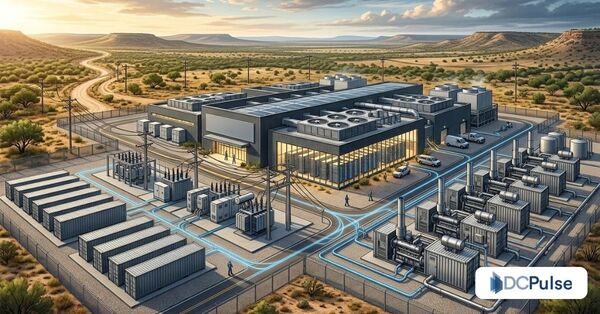
The Energy Vault agreement is structured around an integrated power system rather than a standalone battery installation. The platform combines dispatchable generation, battery storage, grid-forming inverter technology, software controls, and power-generation engineering and procurement capabilities.
A power-generation EPC partner will deploy Caterpillar generator sets as part of the overall infrastructure. Energy Vault will provide the BESS, grid-forming power conversion equipment, and its AI infrastructure control software.
The combination is intended to provide a data center with an integrated electricity supply capable of operating independently from conventional utility interconnection arrangements.
For large AI campuses, that distinction is increasingly important. Conventional data center development can depend on the availability of transmission capacity, utility upgrades, and interconnection approvals. Those processes can extend project schedules even when land and construction plans are already in place.
The Texas project demonstrates how developers are looking at generation and storage as components of the data center itself rather than treating electricity solely as an external utility service.
Off-Grid Architecture Targets Connection Delays
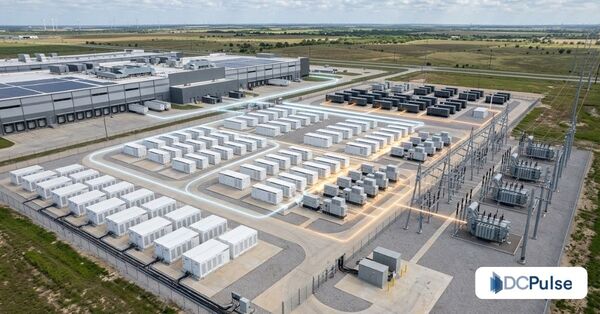
Traditional utility connections remain a significant development consideration for large data centers. AI facilities can require substantial amounts of electricity, creating challenges for utilities and developers attempting to bring new capacity online quickly.
Energy Vault said the integrated system will be deployed as an off-grid power solution, allowing the data center project to avoid reliance on traditional utility interconnection schedules.
The approach could provide developers with greater control over the timing of infrastructure deployment. Instead of waiting for a conventional grid connection to become available, a project can incorporate dedicated generation and energy storage into its initial power architecture.
That does not eliminate the technical or regulatory requirements associated with operating a large power system. It instead changes how those requirements are integrated into the development process.
The model could become particularly relevant for AI campuses where computing capacity needs to come online on a timetable that does not necessarily align with utility infrastructure expansion.
Battery Storage Adds Flexibility to Data Center Power
Battery storage is another important element of the platform. For a data center, batteries can provide more than backup power when they are integrated into a broader power-management architecture.
BESS can help manage changes in electrical demand, support transitions between generation sources, and provide rapid response to fluctuations in the power system.
Energy Vault said its AI monitoring platform will dynamically manage power flows and support voltage and frequency stability. The company also said the system is designed to reduce generator cycling and improve fuel efficiency.
These capabilities are particularly relevant to AI infrastructure because high-performance computing loads can behave differently from more conventional data center workloads. Large numbers of accelerators and other high-density computing systems can create substantial and rapidly changing electrical requirements.
A control layer that coordinates generation, storage, and computing demand can therefore become an important part of the facility's power architecture.
Grid-Forming Technology Supports Independent Operation
Grid-forming power conversion systems provide another layer of functionality within the proposed platform.
Unlike conventional grid-following equipment, grid-forming systems can establish and maintain electrical characteristics within an isolated power network. This capability can be important when a data center operates with its own generation and storage resources.
For an off-grid or islanded data center, maintaining stable voltage and frequency is fundamental to protecting sensitive IT equipment and maintaining continuous operations.
The inclusion of grid-forming technology alongside BESS and generation indicates that the project is being designed as an integrated electrical system rather than a collection of independent backup components.
That architecture could offer data center developers a way to build more flexible power systems around sites where grid capacity is constrained or where traditional interconnection schedules do not match development requirements.
Texas Becomes a Major Test Case
Texas has become one of the most active markets for data center development, particularly as demand for AI infrastructure accelerates.
The state's large electricity market and extensive energy resources have helped attract major digital infrastructure investments. At the same time, rapid growth in electricity demand has increased scrutiny of how large data center loads will connect to and interact with the state's power system.
The Energy Vault agreement arrives within that broader environment. A 1.25GW integrated power deployment illustrates the scale at which developers are beginning to consider dedicated generation and storage for AI infrastructure.
The project also comes as data center operators and technology companies increasingly explore alternatives to waiting for conventional grid capacity.
For Texas, these developments could create a growing market for behind-the-meter generation, battery storage, and advanced power-management systems designed specifically around large digital loads.
Data Center Power Architecture Is Expanding
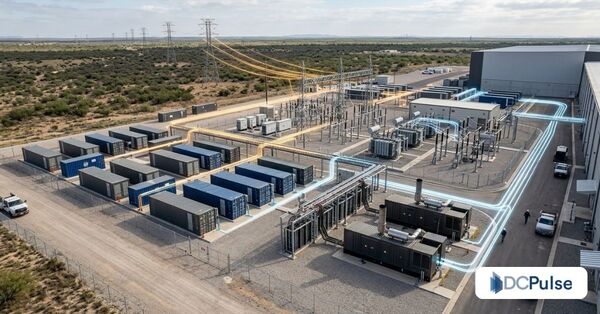
The Energy Vault agreement points to a broader shift in how data center power infrastructure can be designed.
Historically, a data center's electrical architecture has generally been built around utility service, backup generators, UPS systems, and distribution equipment. The growing scale of AI campuses is expanding that model toward more complex combinations of generation, storage, power conversion, and software.
The distinction between primary power and backup power can also become less straightforward in an integrated system. Batteries and generators can work together as part of a continuous power platform rather than operating solely as emergency resources.
Such systems could provide developers with additional flexibility when planning campuses in areas where grid capacity is limited.
The approach may also influence the way data center sites are evaluated. Access to available utility capacity remains important, but developers could increasingly examine the feasibility of developing dedicated power infrastructure alongside land, fiber connectivity, cooling resources, and other site-selection criteria.
Initial Deployments Expected Soon
Energy Vault said initial deployments under the agreement are expected to begin within four to 12 months.
The company has described the agreement as a repeatable commercial platform that could support additional AI infrastructure deployments. The initial Texas deployment is backed by a hyperscaler customer contract, according to the company's announcement.
The disclosed agreement does not identify the specific data center campus or provide a public project location beyond Texas. As a result, the broader development timeline and physical characteristics of the facility remain undisclosed.
The absence of those details also limits how much can be concluded about the project's eventual computing capacity, site footprint, or operational configuration.
Implications for AI Infrastructure Developers
The agreement highlights the increasing importance of power strategy in AI data center development.
Access to electricity is becoming a core development constraint alongside land, fiber, and cooling. A project with sufficient physical space and network connectivity may still face significant delays if the surrounding grid cannot provide the required capacity within the desired construction schedule.
Integrated generation and storage offer one potential response.
The Energy Vault model suggests that future AI campuses could increasingly combine on-site generation, battery storage, power conversion, and intelligent controls into a coordinated infrastructure layer.
For data center operators, the attraction is not simply additional electricity. The larger benefit could be greater control over when and how power becomes available to the computing infrastructure.
The Texas agreement therefore represents more than a large energy-storage contract. It illustrates how the accelerating requirements of AI computing are pushing data center developers to rethink the traditional relationship between a facility and the electrical grid.
As hyperscale campuses continue to grow, dedicated power platforms could become an increasingly important part of the infrastructure strategies used to bring new AI capacity online.