DCPulse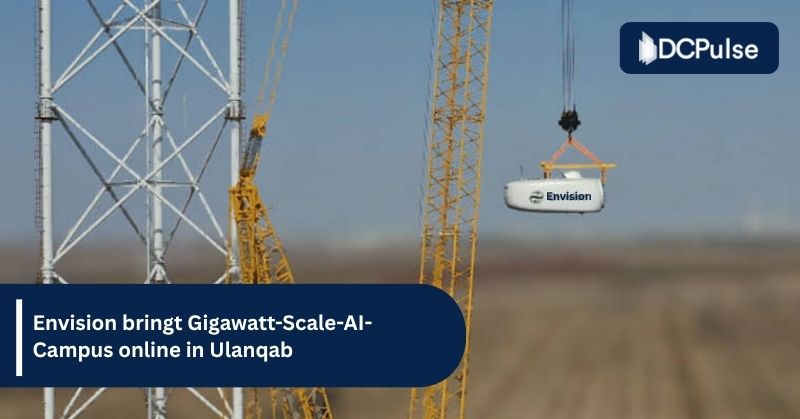
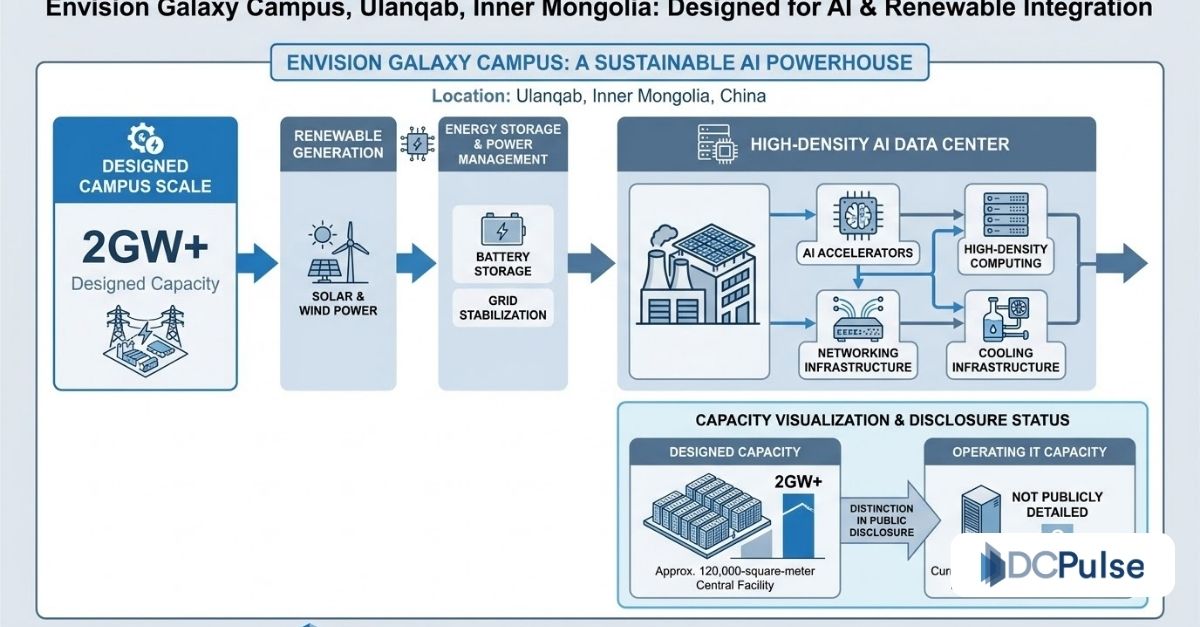
Envision has announced the commissioning of its Galaxy Campus in Ulanqab, Inner Mongolia, introducing a large-scale AI infrastructure model that combines high-density computing with directly connected renewable power. The company says the campus is designed to scale beyond 2GW, although the currently operating capacity has not been publicly detailed.
Envision commissions Galaxy Campus in Ulanqab
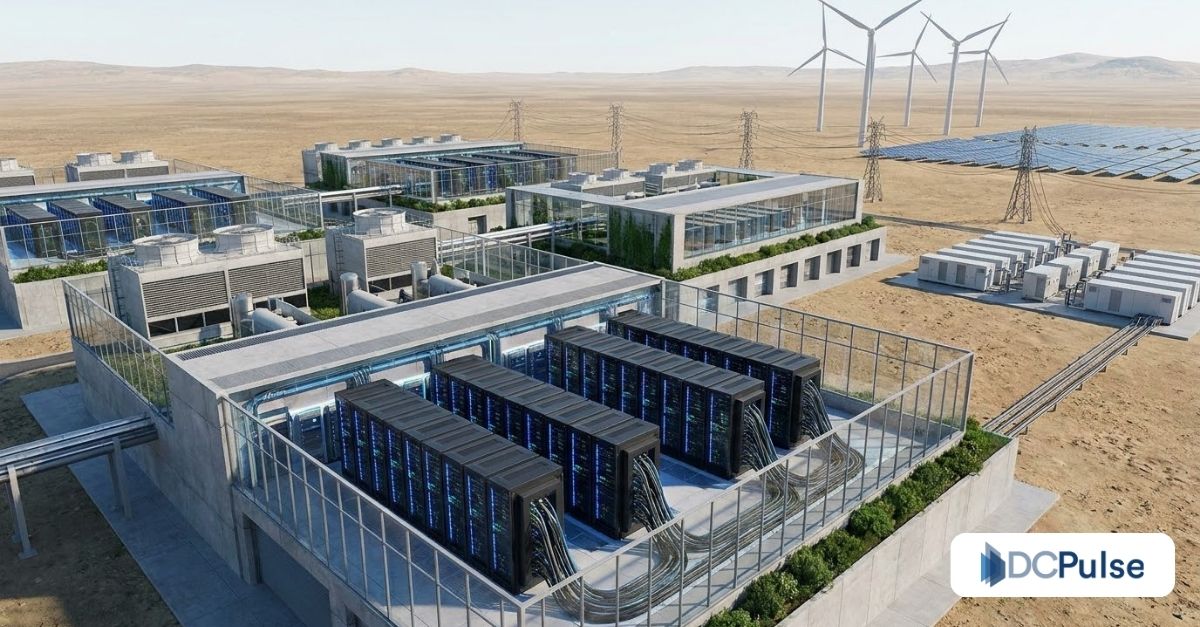
The Galaxy Campus is located in Ulanqab, a city in Inner Mongolia that has increasingly developed as a location for data center and AI infrastructure projects.
Envision announced the campus commissioning on August 6, 2026. The company describes the development as an AI infrastructure campus designed around renewable energy, intelligent power management, and high-density computing.
The central facility covers approximately 120,000 square meters and is intended to operate as an AI supercomputing facility. Envision says the wider campus is designed to scale beyond 2GW of capacity.
The distinction between planned capacity and currently operational capacity remains important. Envision has not disclosed the amount of IT capacity currently operating at the site, meaning the 2 GW figure should be understood as the campus's designed scale rather than confirmed live computing load.
Renewable power is central to the design
The most significant infrastructure characteristic of the Galaxy Campus is its relationship with renewable electricity.
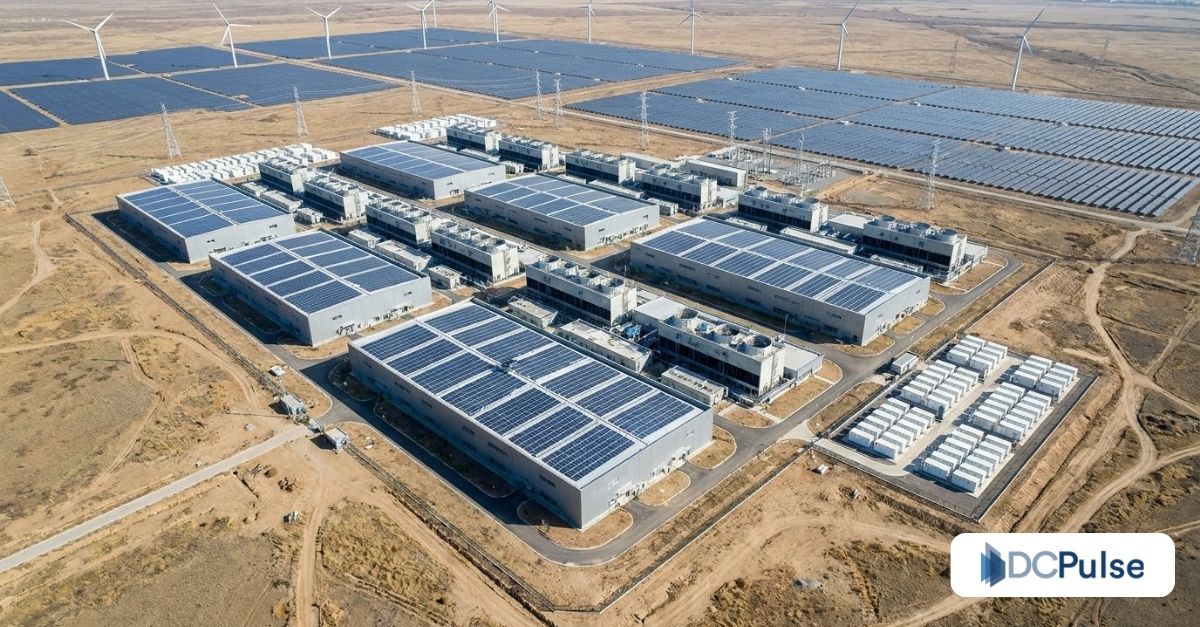
Envision says the campus is powered directly by renewable energy. The company's model integrates renewable generation with transmission infrastructure, energy storage, and its proprietary power-management approach for AI infrastructure.
That configuration reflects a growing industry focus on securing power alongside computing capacity. Large AI facilities can require substantial and consistent electricity supplies, making access to generation and grid infrastructure an increasingly important factor in site selection.
For data center developers, the Ulanqab model also highlights an alternative to relying exclusively on conventional grid connections. Renewable generation located close to computing infrastructure can potentially provide a more integrated energy strategy, although the practical performance of such systems depends on generation availability, storage, transmission, and operational requirements.
High-density AI infrastructure takes shape
The physical scale of the main computing building is another defining feature of the project.
Envision says the 120,000-square-meter facility is designed to support extremely high-density AI computing. At full build-out, the company says the infrastructure is designed to support up to one million AI accelerators and provide one million PFLOPS of AI computing capacity. These figures describe the planned capability of the fully developed facility rather than necessarily representing its initial operating configuration.
The design reflects the changing requirements of AI infrastructure compared with traditional enterprise data centers.
AI workloads increasingly require large numbers of accelerators operating together, creating substantial requirements for power delivery, cooling, networking, and interconnects. Concentrating those systems within a large computing facility requires infrastructure designed around high-density workloads from the outset.
The project therefore illustrates how AI data center architecture is moving toward facilities optimized for accelerated computing rather than conventional server deployments.
Ulanqab emerges as an AI infrastructure location
Ulanqab's position within Inner Mongolia is relevant to the campus's energy strategy.
The region has substantial wind and solar resources, providing a foundation for renewable-powered industrial and digital infrastructure. Envision has also been developing broader energy and industrial projects in Inner Mongolia, including net-zero industrial park initiatives.
Cooler regional conditions can also be relevant to data center operations because environmental conditions influence cooling system design and energy consumption. However, the specific cooling performance and efficiency of the Galaxy Campus have not been independently disclosed in sufficient detail to quantify an operational advantage.
Ulanqab is simultaneously becoming a focus for additional AI infrastructure proposals. Recent reports have identified other major planned AI computing developments in the city, including projects associated with DeepSeek and RedNote.
The concentration of projects could strengthen the city's position as a regional computing hub while increasing demand for power, networking, and supporting digital infrastructure.
Mission Gobi expands the development model
The Galaxy Campus is also linked to Envision's broader Mission Gobi strategy.
Envision announced in June that it planned to develop 5GW of green AI computing capacity in desert and arid regions worldwide by 2030. The Ulanqab campus represents the first flagship project associated with that initiative.
The strategy connects AI infrastructure development with locations where renewable energy resources are available at scale.
Such an approach could influence future data center site selection if computing operators increasingly prioritize access to dedicated renewable generation alongside land and network connectivity. The model is particularly relevant for large AI facilities whose electricity requirements can become a limiting factor in conventional data center markets.
Power and computing become increasingly integrated
The Galaxy Campus illustrates a broader shift in the relationship between data centers and energy infrastructure.
Historically, data center development often began with identifying suitable land, network connectivity, and access to an established electricity grid. AI infrastructure is adding another consideration: the ability to secure very large quantities of power with sufficient reliability and predictable operating characteristics.
Envision's approach places energy infrastructure much closer to the center of the campus design.
Renewable generation, energy storage, transmission, and computing are being considered as interconnected components rather than separate infrastructure systems. This model could become increasingly relevant as AI operators seek to deploy larger accelerator clusters.
The approach does not eliminate the technical challenges associated with renewable-powered computing. Continuous AI workloads require dependable electricity, while renewable generation can vary with weather conditions. Storage, transmission, and energy management therefore remain important components of the overall system.
Implications for data center architecture
The project's scale also has implications for networking and physical infrastructure.
A facility designed to accommodate very large numbers of AI accelerators requires high-bandwidth interconnects between computing systems. Network architecture becomes critical because distributed accelerator clusters can generate substantial internal traffic and require low-latency communication.
Cooling infrastructure is another major consideration. High-density accelerator deployments can produce significantly greater heat loads than conventional server environments, increasing the importance of advanced thermal management.
The Galaxy Campus therefore represents more than an expansion of data center floor space. Its design points toward an infrastructure model in which power delivery, computing density, networking, and cooling are planned together around AI workloads.
A potential model for future green AI campuses
Envision's Ulanqab project provides an example of how large AI infrastructure developments could be located closer to renewable energy resources.
The campus does not yet establish that this model will become the dominant approach for gigawatt-scale AI infrastructure. Its long-term significance will depend on how effectively the planned capacity is brought online, how the energy system performs under sustained computing demand, and how the infrastructure scales.
For the broader data center industry, however, the development demonstrates the increasing convergence of energy and digital infrastructure.
As AI workloads continue to expand, access to electricity is becoming as strategically important as access to land and connectivity. Envision's Galaxy Campus places that relationship at the center of its development strategy, offering a closely integrated example of renewable generation and large-scale AI computing in Inner Mongolia.