Pranav Hotkar
For years, hyperscale data centers were measured in megawatts. Now, the AI era is pushing the industry toward something far larger: gigawatt-scale campuses designed specifically for massive compute clusters.
The shift is being driven by the explosive growth of generative AI, where training and inference workloads require unprecedented concentrations of GPUs, power delivery systems, cooling infrastructure, and network capacity. What once looked like oversized cloud campuses is quickly becoming an industrial-scale energy project.
This is changing the physical footprint of digital infrastructure itself.
Instead of expanding through smaller distributed facilities, technology companies are increasingly pursuing massive AI campuses capable of consuming as much electricity as a mid-sized city. Land acquisition, grid connectivity, water access, and utility partnerships are becoming just as critical as compute performance.
The scale of investment reflects the urgency. Companies are racing to secure power and infrastructure capacity before future AI demand overwhelms existing supply.
The promise is clear: faster AI development and larger computational capability.
The concern is equally significant, whether power grids, communities, and sustainability targets can keep pace with the rise of gigawatt-scale AI infrastructure.
Why Is AI Driving Infrastructure to Gigawatt Scale?
The scale of AI infrastructure is expanding far beyond the traditional model of hyperscale data centers.
Training and running advanced AI models now requires massive GPU clusters operating continuously at extremely high-power densities. What was once considered a large data center, tens of megawatts, is rapidly becoming insufficient for next-generation AI demand. Companies are increasingly planning campuses measured not in megawatts, but in multiple gigawatts of capacity.
This shift is being driven by the sheer energy intensity of AI compute. Industry estimates cited by Reuters Breakingviews show that companies including Meta and xAI are collectively targeting more than 110 gigawatts of future AI data center capacity, with infrastructure costs reaching tens of billions of dollars per gigawatt.
Traditional Hyperscale vs. Gigawatt AI Campus (2026)
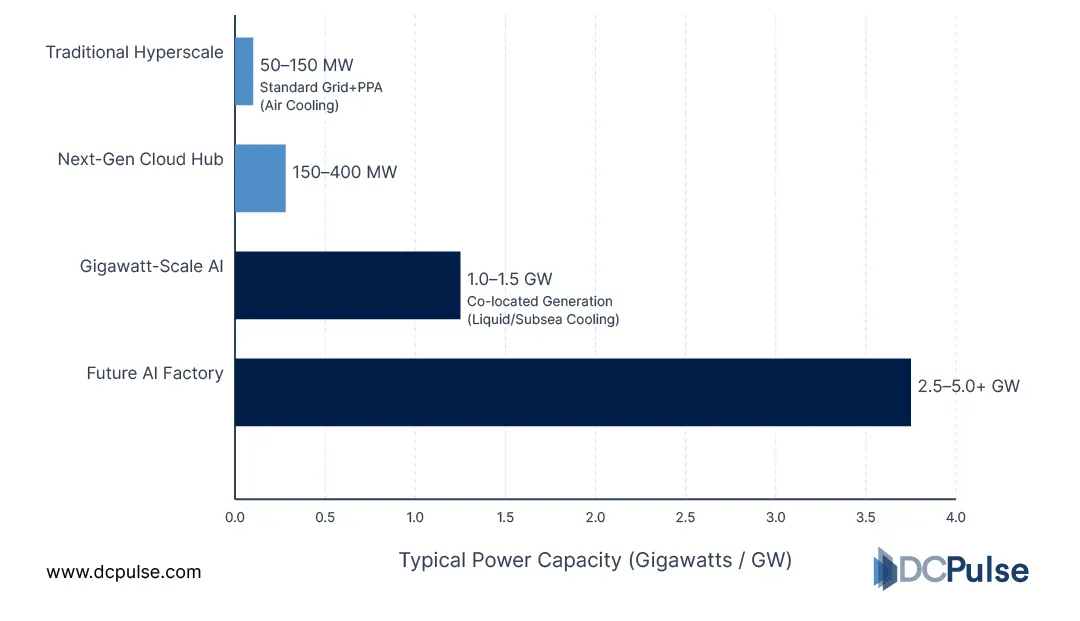
Real projects already reflect this escalation. OpenAI and Oracle’s Stargate initiative includes plans for a 1-gigawatt AI data center campus in Michigan, while a separate UAE-backed AI campus is targeting 5 gigawatts of total capacity.
As demand rises, power infrastructure is becoming the primary constraint. Utilities and governments are struggling to keep pace with grid expansion, transmission capacity, and permitting timelines. In some regions, AI projects are already facing delays because electrical infrastructure cannot support the required load.
This marks a fundamental change in the industry. AI infrastructure is no longer just a digital expansion problem; it is becoming an energy and industrial-scale infrastructure challenge.
Rethinking Campus Design at Gigawatt Scale
Gigawatt-scale AI campuses are forcing a complete redesign of how data center infrastructure is planned, powered, and operated.
Unlike traditional hyperscale facilities, these campuses are increasingly being designed as integrated energy ecosystems rather than standalone buildings. Power delivery is becoming central to the architecture itself, with operators planning dedicated substations, high-voltage transmission access, and phased utility expansion to support future AI growth.
The scale of this transition is already visible. The International Energy Agency states that AI-driven data center growth is expected to significantly increase global electricity demand over the coming decade, placing mounting pressure on grids, transmission infrastructure, and power supply chains.
Power allocation inside a gigawatt-scale AI campus
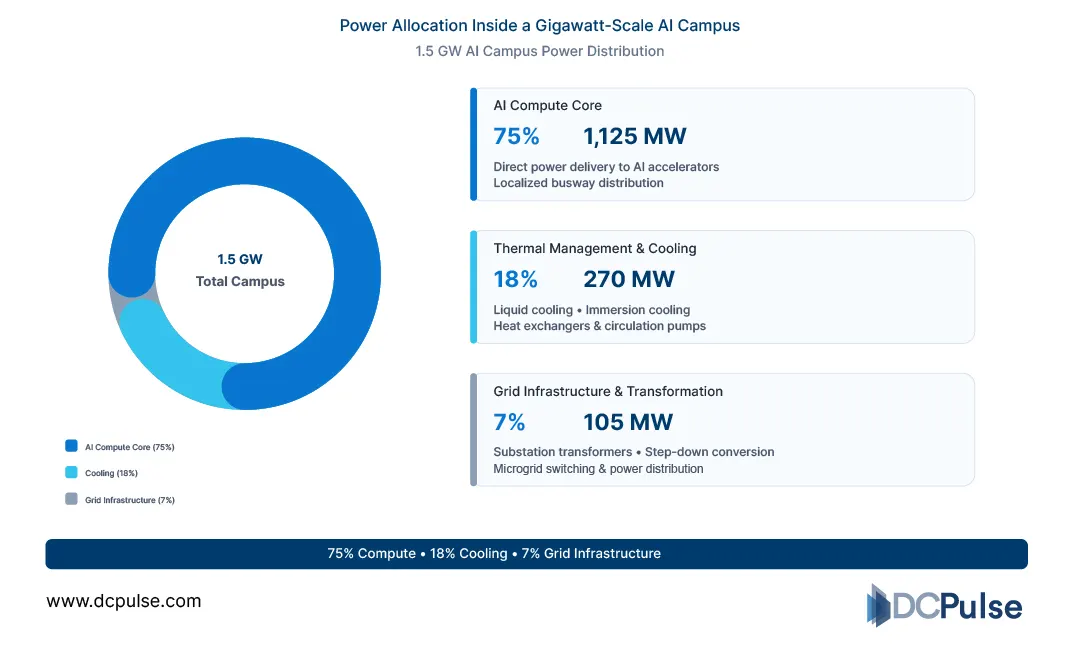
Cooling architecture is also evolving rapidly. As AI rack densities increase, operators are shifting toward large-scale liquid cooling systems integrated directly into campus infrastructure. The IEA notes that energy efficiency, cooling optimization, and grid coordination are becoming critical requirements for next-generation AI facilities.
Rack density growth vs cooling infrastructure complexity
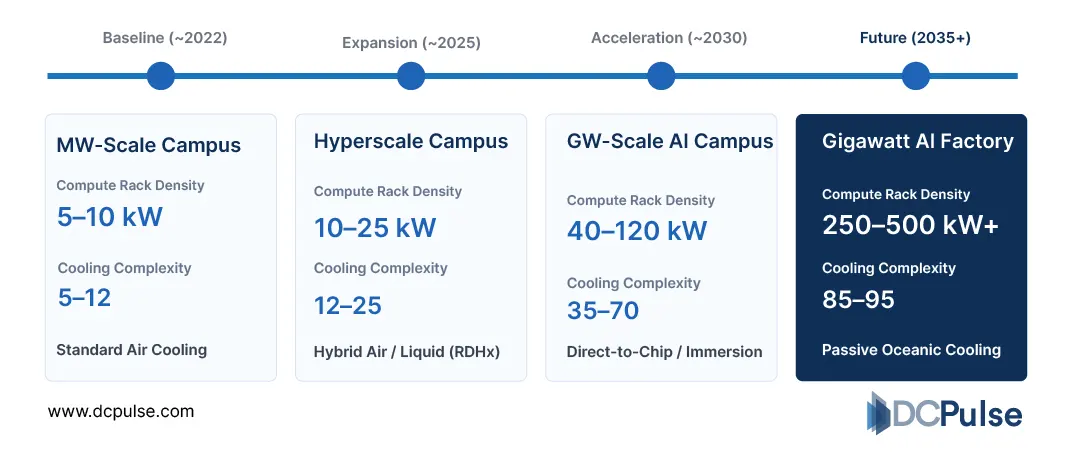
At the same time, modular deployment strategies are becoming increasingly important. Rather than constructing entire campuses at once, operators are scaling infrastructure in phases, allowing compute capacity and utility expansion to grow together over time.
At the gigawatt scale, the AI campus is no longer just a data center. It is becoming a hybrid of utility infrastructure, industrial engineering, and high-performance computing architecture designed around continuous AI expansion.
Who’s Building Gigawatt AI Campuses?
The race to build gigawatt-scale AI infrastructure is no longer theoretical. Major technology companies are already securing land, power agreements, and utility partnerships for campuses designed around massive AI compute demand.
OpenAI, alongside Oracle and SoftBank Group, is pursuing the massive Stargate initiative, a project targeting up to 10 gigawatts of AI computing capacity across multiple U.S. sites. Reuters reported that the consortium plans several large AI data centers as part of a broader infrastructure push estimated at up to USD 500 billion.
Announced AI campus capacity targets by company (MW vs GW scale)
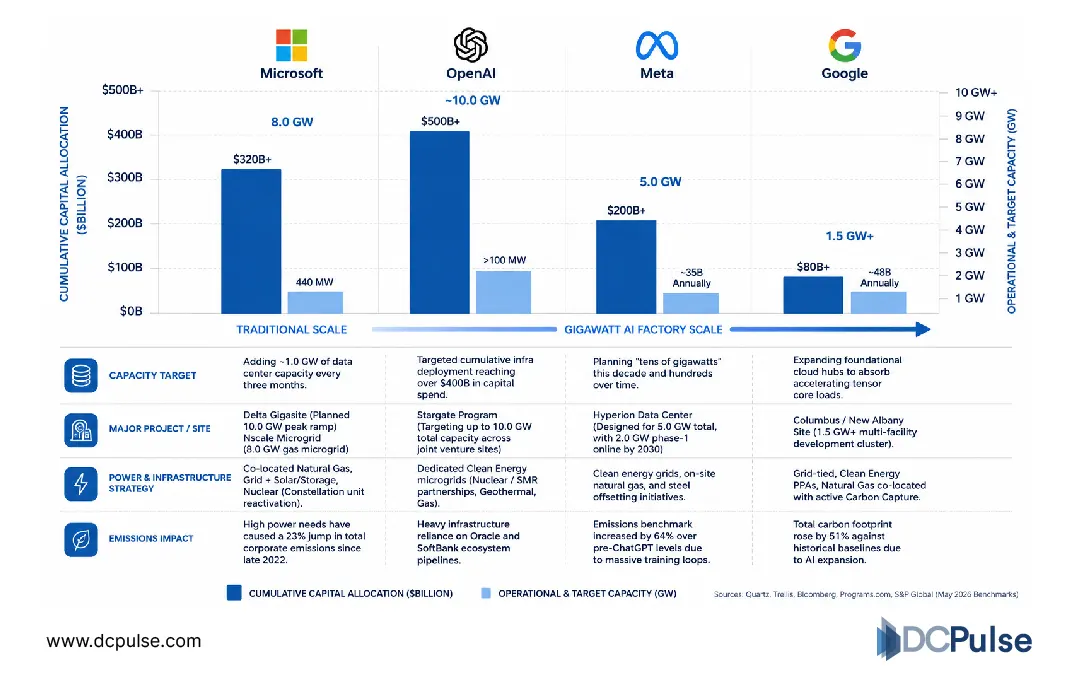
At the same time, xAI is aggressively scaling its Memphis supercomputing footprint. Reuters reported that xAI aims to expand its Colossus infrastructure toward nearly 2 gigawatts of compute power, while also planning facilities capable of housing at least one million GPUs.
The scale of these projects is transforming AI infrastructure into an industrial sector comparable to large-scale energy and manufacturing developments. Research published on arXiv analyzing AI supercomputers found that leading AI systems are rapidly increasing in power demand, with projections suggesting future frontier AI clusters could eventually require multiple gigawatts of electricity.
This shift is also reshaping infrastructure strategy. Instead of expanding traditional hyperscale facilities incrementally, companies are increasingly pursuing integrated AI campuses tied directly to power generation, transmission infrastructure, and utility-scale energy planning.
Gigawatt AI campuses are no longer experimental concepts; they are becoming the physical foundation of the next phase of AI competition.
Are Gigawatt AI Campuses the Future of Computing or an Infrastructure Breaking Point?
Gigawatt-scale AI campuses are rapidly becoming the new model for advanced AI infrastructure, but they also represent one of the biggest energy challenges the technology industry has faced.
The reason for their rise is straightforward. Training frontier AI models now requires enormous concentrations of GPUs, cooling systems, and power infrastructure that smaller facilities can no longer support efficiently. This is pushing hyperscalers toward centralized AI mega-campuses built around direct access to large-scale energy capacity.
However, the challenge is no longer just computing; it is the infrastructure itself.
Power grids, transmission networks, water resources, and permitting systems are already struggling to keep pace with the speed of AI expansion. In many regions, electricity availability is becoming a larger constraint than land or hardware supply.
Despite these pressures, gigawatt campuses are unlikely to slow down. They are becoming critical to the competitive race for AI leadership, especially among hyperscalers building frontier-scale models.
The most likely outcome is concentrated growth. A small number of regions with strong energy infrastructure will emerge as global AI hubs, while other markets struggle to support ultra-scale deployments.
In the end, the future of AI may depend as much on energy capacity as on computing innovation itself.