DCPulse
Enterprise AI adoption is moving beyond isolated experimentation, creating new requirements for the networks that connect applications, data, cloud platforms, and computing infrastructure. Lightpath's focus on its IP backbone highlights how network architecture is becoming an increasingly important part of the infrastructure supporting enterprise AI deployments.
For data center operators and digital infrastructure providers, the development reflects a broader shift in enterprise computing. AI workloads are often distributed across data centers, cloud environments, private infrastructure, and increasingly specialized computing platforms. Connectivity between these locations can therefore influence how effectively organizations deploy and operate AI services.
Lightpath, a provider of fiber-based connectivity and network services, has positioned its IP infrastructure as part of this evolving enterprise environment. The company's services. The company's network strategy illustrates the growing role of IP connectivity alongside physical data center capacity, cloud infrastructure, and AI computing resources.
Enterprise AI Is Expanding the Role of Network Infrastructure
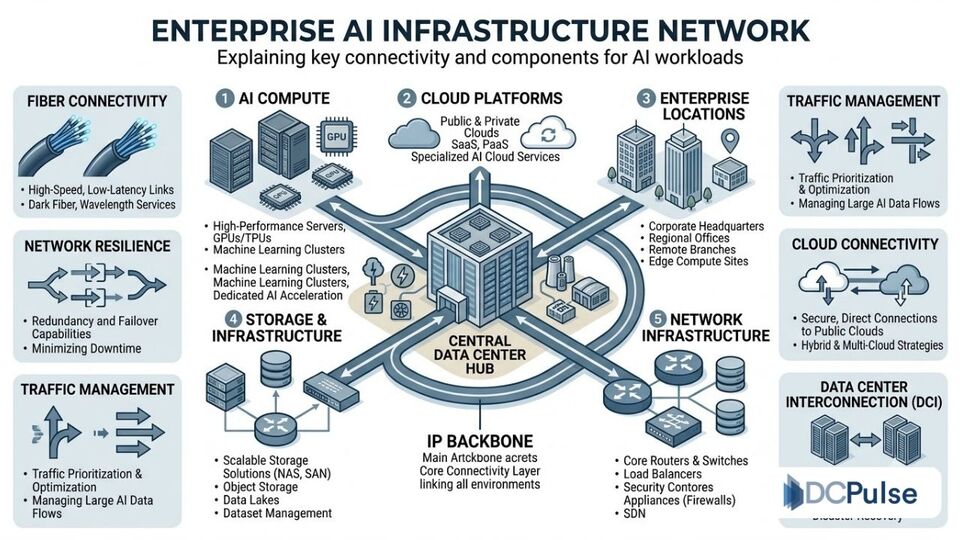
Traditional enterprise applications generally rely on predictable connectivity patterns between users, offices, data centers, and cloud services. AI workloads can introduce more complex traffic flows because data, model training resources, inference environments, and applications may exist across multiple infrastructure locations.
The network consequently becomes an important layer connecting these resources. Data may move between enterprise facilities and cloud environments, while AI applications can require access to large datasets, specialized compute resources, and multiple software services.
For data centers, this evolution increases the importance of network architecture during facility planning. Connectivity is no longer simply an access service for customers or employees. It can form part of the infrastructure that determines how workloads interact across geographically distributed environments.
IP Backbone Infrastructure Connects Distributed AI Environments
An IP backbone provides the underlying network layer through which traffic can move between connected locations. In an enterprise AI environment, that connectivity can link data centers, cloud on-ramps, offices, customer locations, and other digital infrastructure.
Lightpath's infrastructure. Lightpath’s network strategy is relevant to this model because enterprises increasingly operate across multiple infrastructure environments rather than depending on a single facility. A company may retain sensitive data within a private data center while using public cloud resources for selected AI applications. Other workloads may rely on colocation facilities or specialized compute environments.
Such architectures create dependencies between computing capacity and network connectivity. Additional AI infrastructure does not necessarily exist in the same physical location as enterprise data, making the network an important component of the overall architecture.
Data Centers Are Becoming Part of Larger AI Infrastructure Networks

The relationship between data centers and networks is changing as AI infrastructure becomes more distributed. A facility can provide power, cooling, compute space, and physical security, while network infrastructure provides connections to users, cloud platforms, storage systems, and other facilities.
This relationship is particularly relevant for enterprises operating hybrid infrastructure. AI workloads can move between private and public environments depending on application requirements, data considerations, available computing resources, and operational strategy.
For data center providers, network-rich locations can therefore become important infrastructure assets. Fiber availability, diverse network paths, carrier access, interconnection options, and proximity to major connectivity hubs can influence how effectively a facility participates in broader AI ecosystems.
The physical data center remains essential, but its value increasingly depends on how effectively it connects with the infrastructure surrounding it.
AI Workloads Increase the Importance of Traffic Management
AI applications can create different patterns of network traffic compared with conventional enterprise workloads. Model development, data preparation, training, inference, and application delivery can each involve different connectivity requirements.
Training environments may depend heavily on interactions between computing resources and datasets. Inference applications can have different requirements because AI services may need to exchange information with applications and users in near real time.
These differences make network architecture an important consideration when organizations expand AI infrastructure. Capacity alone does not determine network performance. Routing architecture, resilience, latency characteristics, traffic engineering, and the ability to connect multiple infrastructure environments can also affect operational requirements.
For data center operators, this creates a closer relationship between network planning and capacity planning. Electrical and cooling infrastructure may determine how much compute a facility can host, while connectivity determines how that compute interacts with the rest of the digital environment.
Resilience Becomes Critical Across Connected Infrastructure
Enterprise AI adoption also places greater attention on network resilience. A highly available AI application can still experience disruption if its supporting connectivity is dependent on a single network path or infrastructure point.
Network diversity can reduce exposure to individual connectivity failures. Diverse fiber routes, multiple network providers, and appropriately designed interconnection infrastructure can provide additional options for maintaining communications between critical environments.
Data center design can support these requirements through suitable fiber pathways, meet-me rooms, cross-connect infrastructure, and physical route diversity. These considerations are especially relevant for facilities serving enterprises with distributed workloads.
Resilience requirements also extend beyond the individual data center. A facility may have redundant internal systems while remaining dependent on external connectivity infrastructure. End-to-end resilience therefore requires consideration of both facility-level and network-level dependencies.
Cloud Connectivity Remains a Key Enterprise Requirement
Enterprise AI adoption is closely connected with cloud computing because organizations can access AI platforms, infrastructure services, storage, and software through cloud environments. Private infrastructure and public cloud resources may consequently operate as complementary components.
Network connectivity provides the link between these environments. Enterprises can use dedicated or specialized connections to support communication between data centers and cloud platforms, depending on their architecture and requirements.
For data center operators, this reinforces the importance of cloud connectivity and interconnection ecosystems. Facilities with access to multiple cloud providers and network services can serve as connection points within increasingly distributed enterprise architectures.
The trend also places greater emphasis on predictable and secure connectivity between infrastructure locations. AI applications can depend on data and computing resources that are separated geographically, making the network an integral part of the service architecture.
The Implications for Data Center Development
The expansion of enterprise AI could influence how organizations evaluate future data center locations and infrastructure requirements. Power availability and cooling capacity remain fundamental considerations, particularly as high-density computing increases demand for specialized infrastructure.
Connectivity adds another dimension to that evaluation. Fiber availability, network diversity, interconnection opportunities, and access to cloud ecosystems can affect the suitability of a facility for distributed AI workloads.
Data center developers may therefore need to consider network infrastructure earlier in the development process. Fiber routes and connectivity options can influence site selection, while internal pathways and interconnection spaces can affect how easily a facility adapts to future requirements.
The same considerations apply to existing facilities. Older data centers may have adequate physical capacity but face limitations related to connectivity pathways, carrier diversity, or interconnection infrastructure.
Enterprise AI Is Creating a More Connected Infrastructure Model
Lightpath’s IP backbone strategy sits within a wider infrastructure transition in which enterprise AI is becoming increasingly dependent on interconnected computing environments. Data centers, cloud platforms, networks, and enterprise locations are increasingly functioning as parts of the same digital infrastructure system.
For DC Pulse readers, the significance lies beyond the network itself. AI adoption is creating a need to evaluate computing infrastructure and connectivity as interconnected layers rather than independent assets.
The next phase of enterprise AI will continue to depend on access to computing capacity, reliable power, efficient cooling, secure data environments, and robust network connectivity. As these requirements converge, the network connecting AI infrastructure may become just as important to deployment strategy as the physical facilities hosting the workloads.
Lightpath’s IP backbone provides one example of this broader shift. Enterprise AI is moving toward an infrastructure model where the performance and resilience of applications depend on the combined capabilities of data centers, cloud environments, and the networks linking them.