DCPulse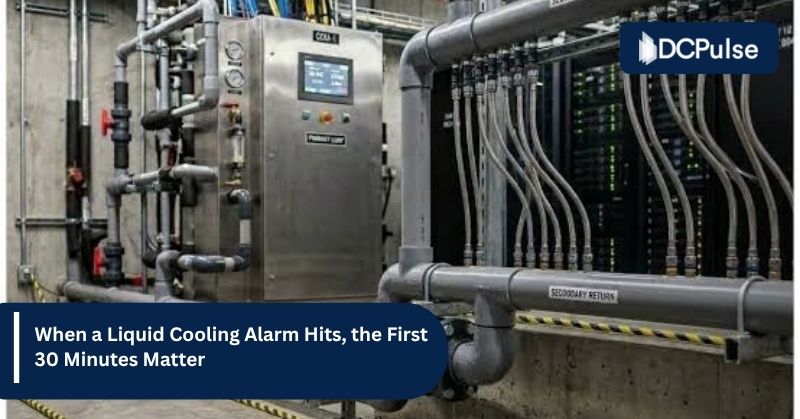
A liquid cooling alarm in an AI data center is more than a mechanical warning. It can indicate a change in coolant flow, pressure, temperature, fluid level, or a possible leak somewhere between the facility cooling system and the GPU rack.
The operational significance is increasing as AI infrastructure moves toward higher-density computing. ASHRAE's AI Data Center Energy Performance Framework identifies liquid cooling, including direct-to-chip systems, as an important architecture for high-density AI deployments and describes technology cooling systems as an integrated combination of liquid loops, coolant distribution units (CDUs), pumps, valves, sensors, controls, and heat rejection equipment.
For operators, the first 30 minutes after an alarm are therefore less about a single piece of equipment and more about establishing what has changed, where the problem is located, and whether thermal or equipment risk is developing.
The First Signal Needs Context
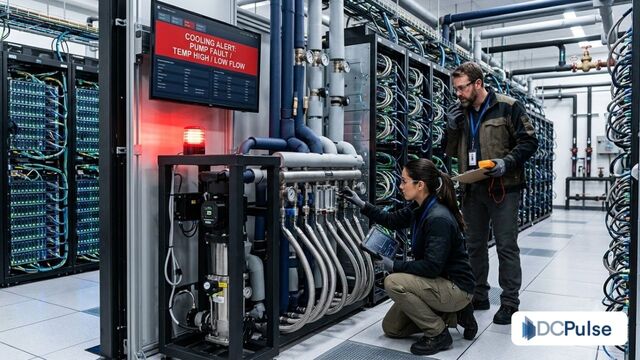
The first alarm does not necessarily identify the underlying failure.
A liquid cooling system can generate alerts associated with flow, pressure, temperature, coolant level, or leak detection. Modern CDUs can incorporate flow monitoring, alarm functions, remote monitoring, and leak detection, while broader facility systems can collect information from cooling equipment and sensors through building management or data center infrastructure management platforms.
The first minutes should therefore establish the alarm's source and severity rather than treating every alert as evidence of a confirmed leak.
A flow alarm at a CDU, for example, describes a different condition from a moisture alarm beneath a rack. A temperature deviation can also require a different response from a sudden pressure or fluid-level change.
The alarm history matters as well. A single transient reading can have a different operational meaning from a parameter that continues moving away from its normal range.
Minutes 0 to 5: Establish the Affected Zone
The first five minutes are primarily about situational awareness.
The affected cooling loop, CDU, rack group, manifold, or individual compute system needs to be identified from the available monitoring information. Liquid cooling architectures can include both facility-side and IT-side loops, with CDUs providing the interface between facility water systems and technology cooling circuits.
The distinction is important because the physical location of the alarm can narrow the potential impact.
A facility-level problem may affect multiple racks, while an issue associated with a particular manifold or compute node can potentially be contained to a smaller portion of the environment. Open Compute Project guidance notes that leak detection can occur at multiple points, including the CDU, rack, chassis, quick-disconnect couplings, and compute node.
The operator's first objective is consequently to establish the boundary of the incident.
Minutes 5 to 10: Confirm Whether Cooling Performance Is Changing
The next stage concerns the thermal condition of the affected equipment.
Temperature, flow, pressure, and coolant-level information can help operators determine whether the alarm corresponds with an actual change in cooling performance. ASHRAE identifies instrumentation for temperature, pressure, flow, and leak detection as part of the controls architecture for technology cooling systems.
The relationship between these measurements can be more informative than an individual alarm.
A falling flow rate accompanied by a pressure change can point toward a different condition than a temperature alarm without a corresponding change in liquid parameters. Similarly, a leak-detection signal combined with a declining fluid level provides a different operational picture from an isolated sensor event.
The objective during this period is not necessarily to identify the final root cause. The immediate requirement is to determine whether the cooling system remains within its operating envelope and whether the affected IT equipment is experiencing increasing thermal risk.
Minutes 10 to 15: Protect the Cooling Boundary
The next 10 minutes can become critical when monitoring indicates an actual liquid-system problem.
Modern liquid cooling designs increasingly use isolation, redundancy, containment, and automated monitoring to limit the consequences of component failures. ASHRAE's AI framework specifically identifies N+1 or 2N pumping and heat-exchange redundancy, dual IT and facility loops, continuous leak detection, redundant telemetry, and emergency heat-rejection strategies as reliability considerations for AI data centers.
The precise response depends on the facility's engineered procedures and the type of cooling architecture in use.
A direct-to-chip system, rear-door heat exchanger arrangement, and other liquid-cooling configurations do not necessarily present the same operational conditions. The relevant isolation points, bypass arrangements, redundancy, and shutdown procedures therefore need to be established before an incident occurs.
The key operational principle is containment. A localized cooling issue should not automatically become a wider cooling-system disruption.
Minutes 15 to 20: Evaluate IT and Workload Exposure
The IT layer becomes increasingly important once the cooling condition has been established.
AI infrastructure can concentrate substantial computing and thermal loads within relatively small areas. ASHRAE notes that GPU-centric AI systems are driving new power densities and thermal loads, creating requirements for different cooling, resilience, and operational strategies.
A cooling alarm therefore needs to be correlated with the workloads operating on the affected equipment.
The relevant questions include whether GPU temperatures are changing, whether affected racks remain within their permitted operating conditions, whether redundant cooling capacity is available, and whether workload management systems can reduce thermal exposure if required.
This connection also extends into digital infrastructure. A thermal incident that affects an AI cluster can potentially affect compute availability, networking activity, storage operations, and applications that depend on that cluster.
Minutes 20 to 25: Move From Incident Detection to Controlled Recovery
The 20-minute mark should represent a transition from initial detection toward a controlled recovery decision.
Maintenance and engineering teams can use the available telemetry to determine whether the condition is stable, improving, or deteriorating. A localized leak may require isolation and repair, while a sensor anomaly may require validation before physical intervention.
The condition of the liquid itself can also matter. ASHRAE warns that insufficient cleanliness and preparation of hydronic systems can create problems for liquid-cooled IT equipment, while proper cleaning, flushing, and passivation are important during commissioning.
Fluid quality is therefore part of long-term reliability, not simply an issue that appears after a leak.
The recovery process also needs to account for the possibility that equipment has been exposed to fluid. Returning a system to service should depend on the facility's documented procedures and the condition of the affected equipment rather than the passage of a predetermined amount of time.
Minutes 25 to 30: Decide Whether the Incident Is Contained
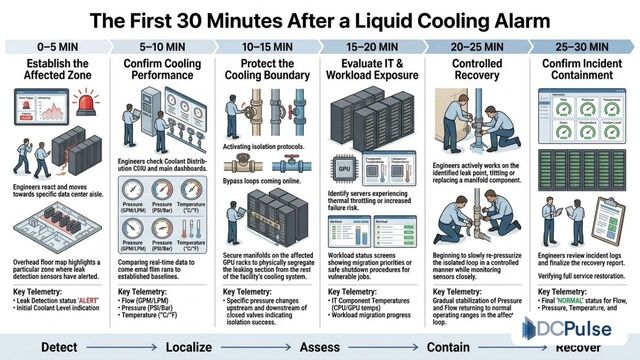
By the end of the first 30 minutes, the most useful outcome is a clear incident status.
A contained event has an identified location, stable operating conditions, adequate cooling capacity, and a defined repair or inspection path. An unresolved event has continuing abnormal telemetry, uncertain equipment exposure, or insufficient cooling redundancy.
That distinction matters because AI data center operations depend on coordination between IT, mechanical, electrical, facilities, and controls teams.
Schneider Electric's data center reference architecture, for example, describes the aggregation of sensor information from cooling and other critical assets into BMS, EPMS, DCIM, and related systems.
A liquid cooling alarm therefore becomes an operational data problem as well as a mechanical problem. The quality and availability of telemetry can influence how quickly operators establish the incident boundary and determine the appropriate response.
Liquid Cooling Makes Monitoring a Core Infrastructure Function
The growing deployment of liquid cooling changes the role of facility monitoring in AI data centers.
Traditional data center operations already depend on monitoring for power, temperature, humidity, and mechanical systems. Liquid cooling adds another layer involving fluid movement, pressure, temperature, quality, leak detection, valves, pumps, manifolds, and CDUs.
The Open Compute Project's recent liquid-cooling guidance emphasizes that leak prevention should be supported by a detailed leak detection and intervention plan appropriate to the data center environment.
That requirement places greater importance on commissioning, sensor coverage, alarm configuration, operator training, and clearly defined escalation procedures.
The First 30 Minutes Begin Before the Alarm
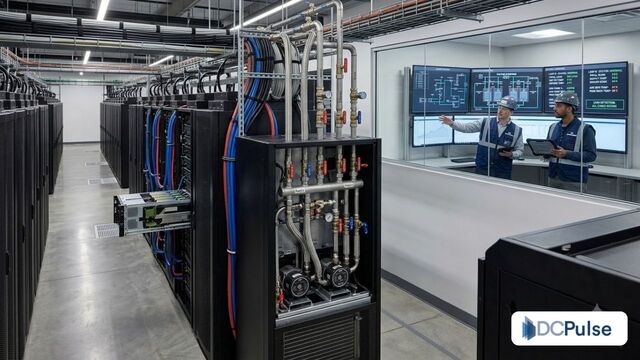
The most important preparation for a liquid cooling incident happens before an alarm appears.
AI data centers need clearly documented cooling zones, known isolation points, reliable telemetry, tested alarm paths, defined escalation procedures, and maintenance teams familiar with the particular liquid-cooling architecture.
ASHRAE's AI framework treats commissioning and performance validation as critical elements of AI data center deployment, while its liquid-cooling guidance emphasizes leak detection, containment, redundancy, and instrumentation as parts of the overall technology cooling system.
For operators, the first 30 minutes should therefore be viewed as a test of the entire cooling architecture rather than simply a response to an individual alarm.
In an AI data center, liquid cooling sits directly between high-density compute and the infrastructure responsible for removing its heat. A small anomaly can remain localized when monitoring, containment, and response systems work together. The same anomaly can become more disruptive when operators lack visibility into the affected loop or cannot quickly establish whether IT equipment remains thermally stable.
The real measure of liquid cooling resilience is consequently not whether alarms occur. It is whether the data center can detect, localize, contain, assess, and recover from a cooling abnormality without allowing a localized event to become a wider infrastructure disruption.