Pranav Hotkar
Net-zero data centers are a growing ambition, but achieving them is far more complex than switching to renewable energy. The path is clear in theory, yet far less defined in practice. It requires rethinking how facilities are powered, built, and operated across their entire lifecycle.
The challenge goes beyond energy consumption. While renewable power can address a significant portion of operational emissions, it does little to eliminate the carbon embedded in infrastructure, hardware, and supply chains. A data center can run on clean electricity and still fall short of net-zero because much of its footprint lies outside day-to-day operations.
At the same time, net-zero is quickly becoming a competitive and strategic target across the industry. Operators are setting ambitious timelines, but the real test is not setting the goal; it is proving how to get there.
In this context, net-zero is no longer a single initiative. It is a multi-layered transformation that spans energy, design, and lifecycle management, defining how the next generation of data centers will be built and evaluated.
How close are data centers to achieving net-zero operations today?
Data centers are progressing toward net zero, but progress remains uneven across scope 1, 2, and 3 emissions, creating a structural gap between operational decarbonization and full lifecycle neutrality.
Net-zero accounting in the industry is based on the Greenhouse Gas Protocol, which divides emissions into three categories: Scope 1 (direct fuel use and on-site emissions), Scope 2 (purchased electricity), and Scope 3 (value chain emissions, including supply chain and embodied carbon). Scope 3 typically represents the largest and least controlled portion of total emissions in infrastructure-heavy industries such as data centers.
GHG Emissions Distribution
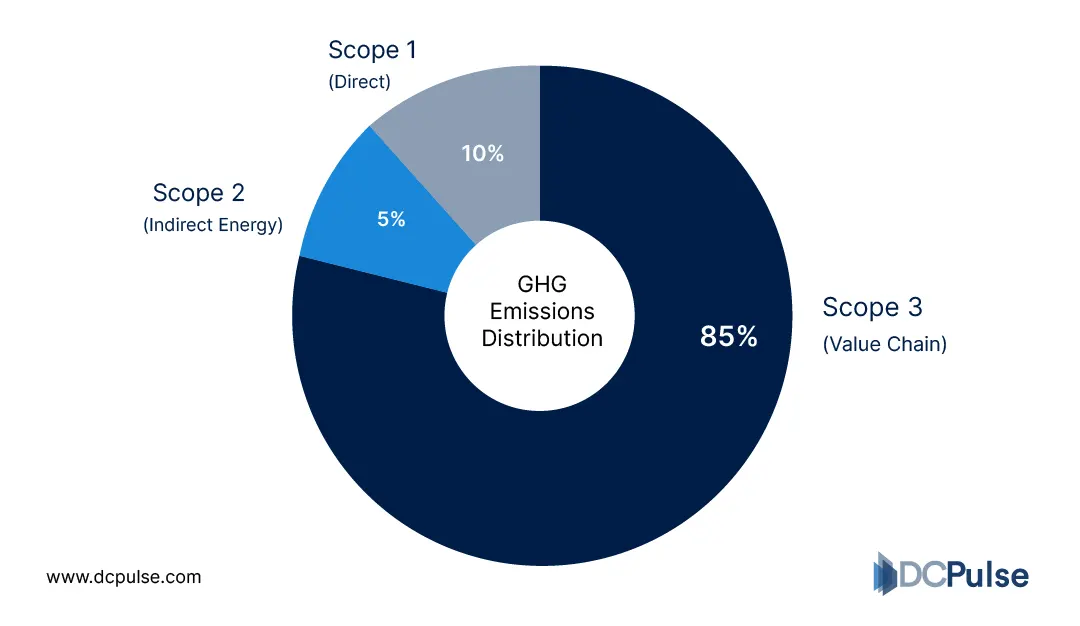
On the operational side, most progress has been achieved in Scope 2 through renewable energy procurement, power purchase agreements, and market-based accounting mechanisms. However, research shows this reflects energy sourcing rather than real-time decarbonization of consumption, meaning emissions reductions depend heavily on accounting frameworks and grid matching rather than physical elimination.
Scope 1 emissions remain comparatively small but persistent, primarily driven by backup diesel generation and refrigerant leakage from cooling systems. These are operationally necessary for resilience, making full elimination technically challenging without redesigning redundancy models.
The largest barrier remains Scope 3. Lifecycle studies consistently show that embodied carbon from server manufacturing, construction materials, and supply chains can dominate total emissions over a facility’s lifetime, yet these emissions are the least consistently measured and hardest to control due to fragmented supplier data and inconsistent reporting boundaries.
Data Center Emission Profile - Operational vs. Embodied Emissions
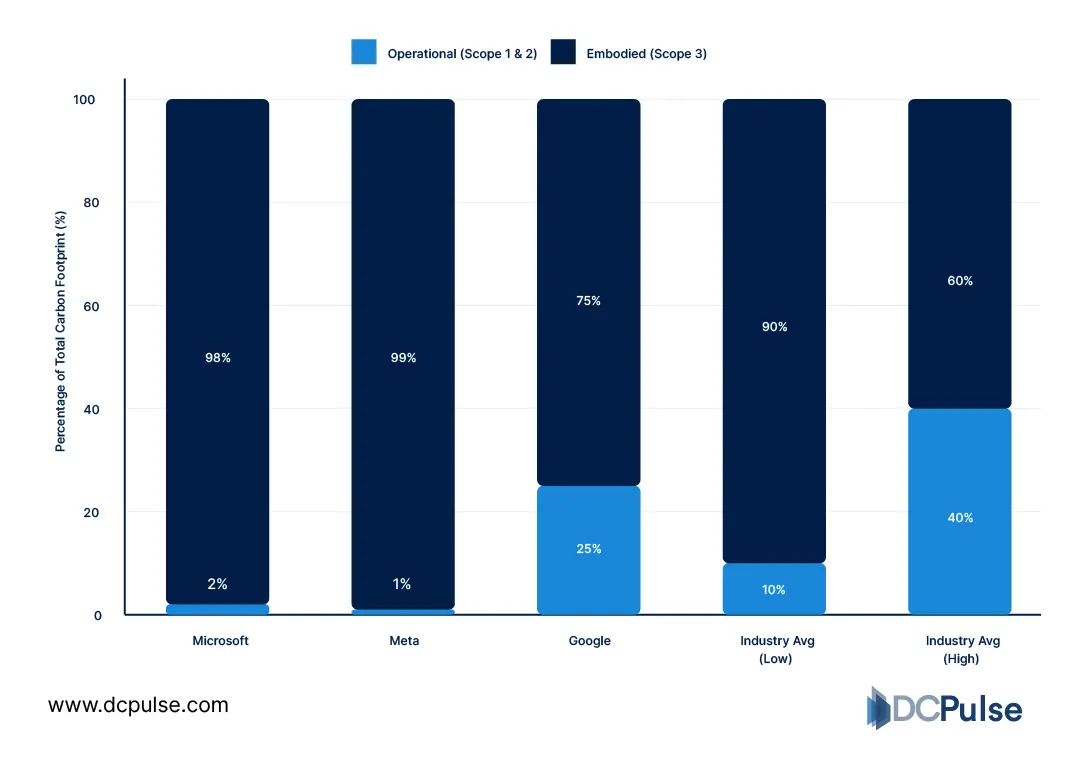
As a result, most “net-zero” claims today reflect operational alignment rather than full lifecycle neutrality, highlighting the gap between ambition and measurable system-wide decarbonization.
What innovations could make net-zero data centers achievable?
Achieving net-zero operations will require more than incremental efficiency gains. The industry is increasingly exploring system-wide changes across energy, cooling, backup power, and infrastructure lifecycle management.
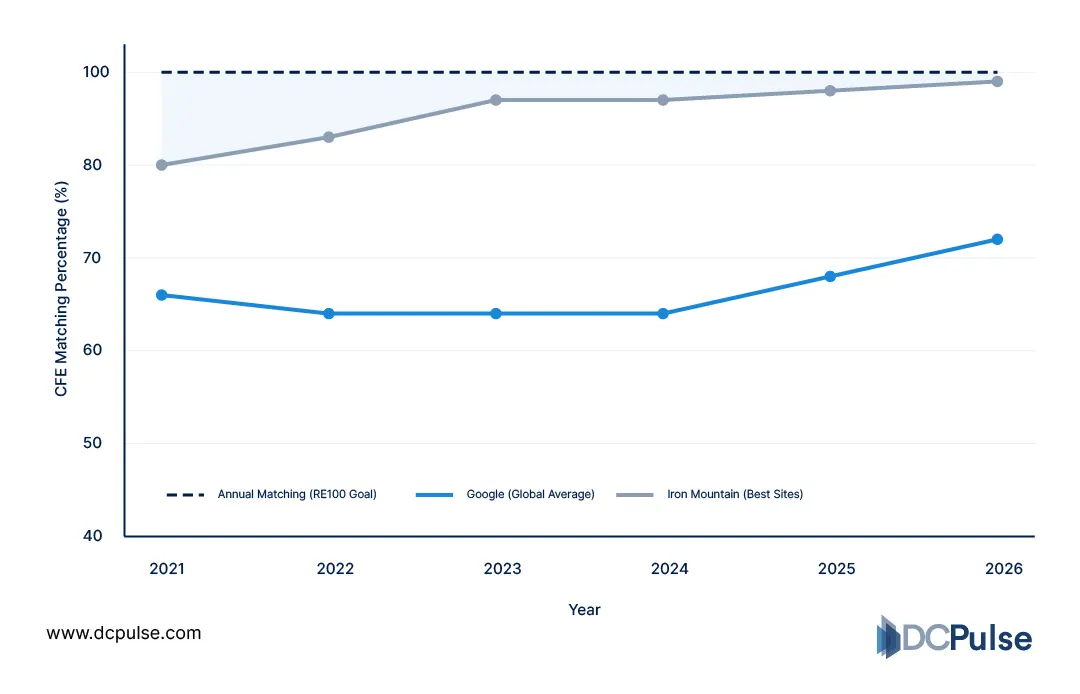
One of the most important shifts is the move toward 24/7 carbon-free energy, where electricity consumption is aligned with clean energy availability on an hourly basis rather than balanced annually through offsets or renewable certificates. This model is increasingly viewed as a more accurate representation of operational decarbonization because it reflects when clean energy is actually available on the grid.
Progress Toward 24/7 Carbon-Free Energy (CFE) Alignment
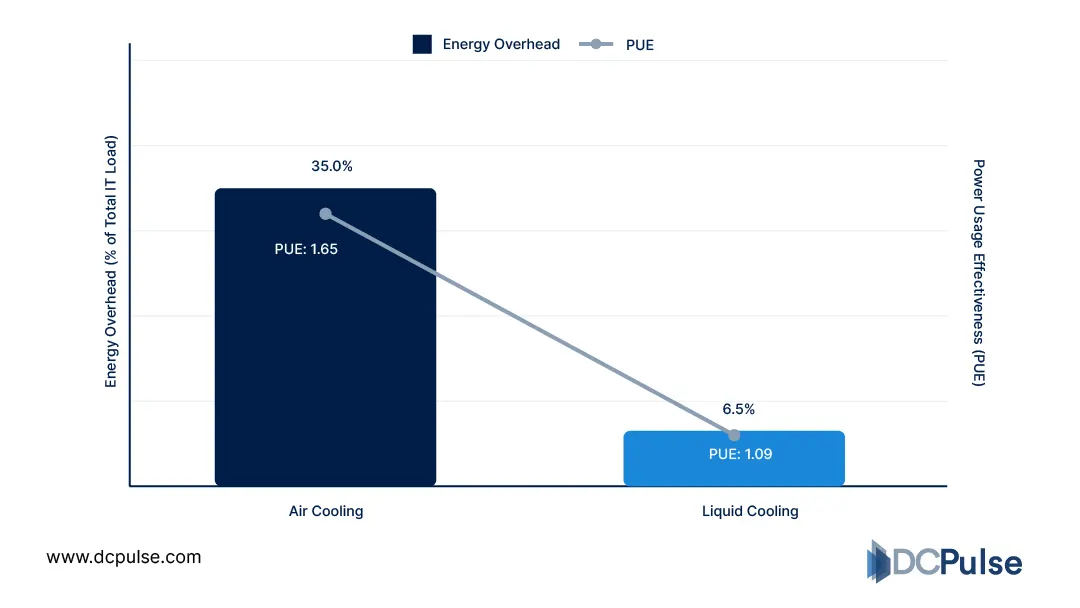
Cooling innovation is also accelerating. As AI workloads increase rack densities, operators are expanding the use of liquid cooling systems to improve thermal efficiency and reduce power overhead associated with large-scale air movement. Uptime Institute research notes that traditional air cooling is approaching practical efficiency limits in high-density environments, pushing the industry toward liquid-based architectures.
Air Cooling vs. Liquid Cooling Efficiency Metrics
Backup power remains one of the hardest operational emissions sources to eliminate. Industry efforts are increasingly focused on alternatives such as hydrotreated vegetable oil (HVO), battery energy storage, and hydrogen fuel cells to reduce dependence on diesel generation.
Beyond operations, innovation is expanding into Scope 3 reduction through lower-carbon construction materials, circular hardware reuse, and supplier-focused procurement strategies aimed at reducing embodied emissions across the infrastructure lifecycle.
Together, these developments show that net-zero data centers will depend less on isolated technologies and more on coordinated lifecycle-wide engineering and operational strategies.
Which companies are shaping the path toward net-zero data centers?
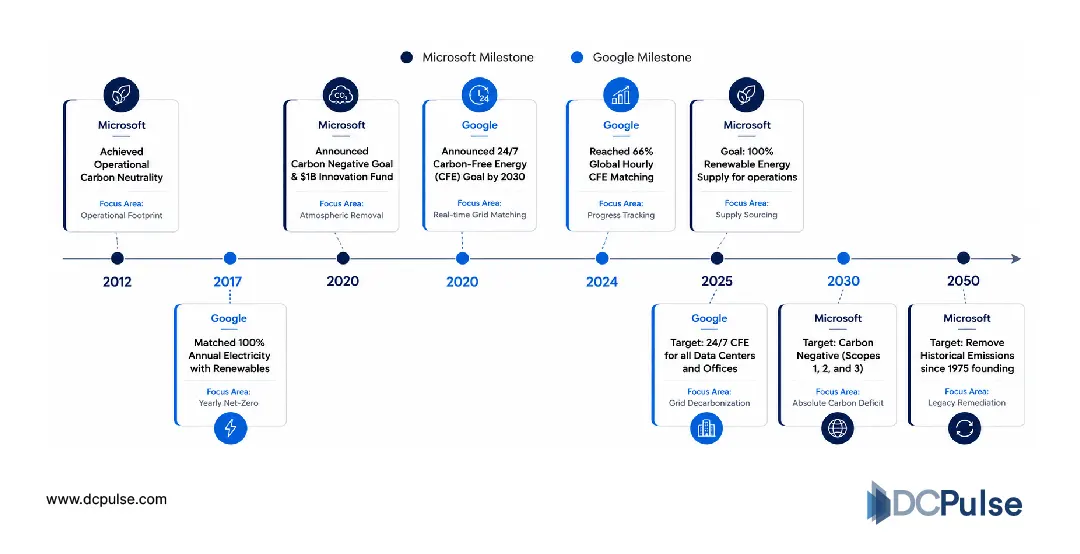
The transition toward net-zero data centers is increasingly being driven by companies adopting measurable, lifecycle-based decarbonization strategies rather than relying solely on renewable energy procurement. Google is focusing on operational decarbonization through its goal of achieving 24/7 carbon-free energy by 2030, aiming to align electricity consumption with clean energy availability on an hourly basis rather than through annual renewable matching alone.
Microsoft is taking a broader lifecycle approach through its carbon-negative by 2030 strategy. The company’s sustainability roadmap includes low-carbon construction materials, circular infrastructure practices, and supplier accountability programs designed to reduce Scope 3 emissions tied to hardware manufacturing and infrastructure development.
Google's 24/7 carbon-free energy target vs. Microsoft's carbon-negative roadmap.
In the colocation sector, Equinix is emphasizing renewable energy procurement, science-based emissions targets, and independently assured Scope 1, 2, and 3 reporting as part of its long-term sustainability strategy. At the infrastructure level, Schneider Electric is focusing on energy management systems, supply chain decarbonization, and operational efficiency programs that extend beyond individual facilities into broader data center ecosystems.
Together, these initiatives show that net-zero data centers are evolving from a power procurement challenge into a broader infrastructure transformation involving energy, materials, operations, and lifecycle accountability.
What will ultimately determine whether data centers can truly reach net-zero operations?
Reaching net-zero operations will depend on far more than renewable energy adoption alone. The next phase of decarbonization will require data centers to manage emissions across the entire infrastructure lifecycle, from power sourcing and cooling systems to construction materials, hardware supply chains, and operational resilience.
This shift changes the nature of sustainability itself. Efficiency metrics and annual renewable matching may continue to play an important role, but they are no longer sufficient indicators of real environmental impact. Increasingly, the focus is moving toward measurable, real-time carbon reduction and deeper visibility into Scope 3 emissions.
As a result, infrastructure strategy, procurement decisions, and operational planning are beginning to converge into a single sustainability framework. The companies that succeed will be those capable of integrating energy, cooling, backup power, and supply chain accountability into one coordinated system rather than treating them as isolated initiatives.
The implication is clear: net-zero data centers will not be achieved through a single technology or offset strategy. They will be built through continuous lifecycle optimization, transparent reporting, and engineering decisions designed around carbon as a core operational constraint.