DCPulse
The proposed Stillwater Technology Park data center in Lovejoy, south of Atlanta, has been withdrawn, removing a planned gigawatt-scale campus from Georgia’s development pipeline. The project’s withdrawal also highlights the growing challenges facing large data center developments as communities, utilities, and local governments weigh the infrastructure requirements associated with hyperscale and AI facilities.
Stillwater Technology Park proposal withdrawn
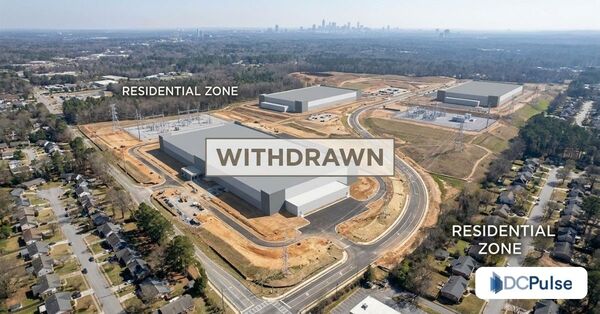
Stillwater Development has withdrawn its application for the proposed Stillwater Technology Park in Lovejoy, Georgia, following months of public engagement around the project. The city confirmed the withdrawal at a special council meeting in August 2026.
The proposed development was planned for a site at 11760 Panhandle Road, roughly 24–25 miles south of downtown Atlanta. Instead of continuing with the data center proposal, the property owner and development team intend to pursue residential development for the site.
The withdrawal occurred before construction began, meaning the project will not contribute the planned computing capacity, electrical load, or associated digital infrastructure investment to the Atlanta-area market.
A large-scale campus planned for 400 acres
The Stillwater Technology Park represented a substantial proposed addition to the Southeast’s data center pipeline.
Planning documents described a campus of up to 15 data center buildings across approximately 400 acres. Each building was planned at about 321,000 square feet, producing a potential total of approximately 3.465 million square feet of data center space at full build-out.
Central Georgia EMC was identified as the prospective grid provider. Project documents indicated a potential electrical capacity of up to 1.25GW, placing the proposal among the largest data center developments being considered in the region.
The initial project plan also contemplated a phased development, with the first phase potentially reaching completion by 2031. The proposal had been reported as having a potential value of up to $13 billion.
For the Atlanta data center market, the scale was significant because a campus of this size would have required substantial coordination between land development, electrical infrastructure, substations, fiber connectivity, cooling systems, and construction supply chains.
Community considerations become a central factor.
Community engagement played an important role in the project's eventual withdrawal.
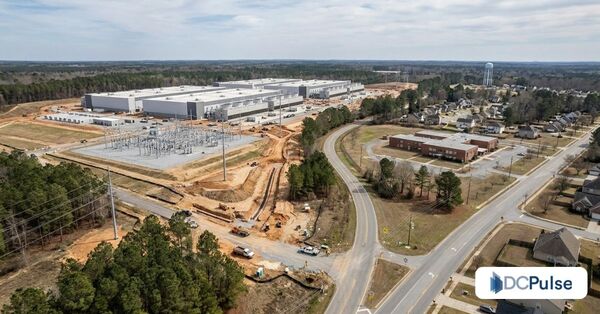
The proposed site is near Michelle Obama STEM Elementary Academy, Eddie White Middle School, and residential neighborhoods. Local concerns included the potential effect of additional traffic on Panhandle Road, particularly around existing school traffic.
The proximity of large digital infrastructure projects to established residential and educational areas can create planning challenges that extend beyond the data center itself. Large campuses can require extensive construction activity, electrical infrastructure, backup systems, cooling equipment, and road improvements, making land-use compatibility an increasingly important consideration.
Lovejoy officials have also indicated that the city intends to review its zoning framework for data center development. Atlanta News First reported that the city council planned to begin work on zoning changes that could restrict future data center construction in the city.
That policy response could become relevant for future developers evaluating sites in the wider Atlanta region.
Power remains a defining requirement
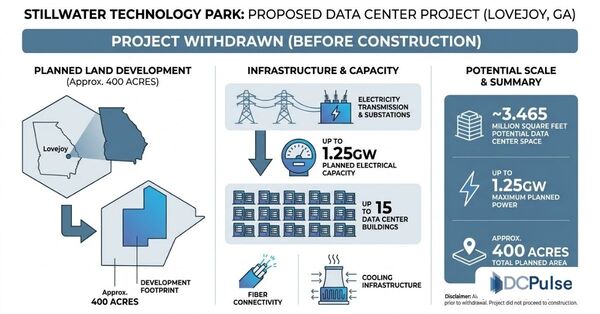
The proposed 1.25GW electrical requirement illustrates the scale of power infrastructure now associated with some hyperscale and AI-oriented data center projects.
A development of this magnitude is not simply a building project. It requires coordination with utilities and potentially new or expanded substations, transmission infrastructure, and other grid facilities. The proposed Stillwater campus was expected to have two on-site substations, according to the project's development application.
The withdrawal therefore has implications beyond the project parcel. A large proposed load that does not proceed can alter assumptions around future electricity demand, infrastructure planning, and utility investment.
At the same time, the cancellation does not eliminate the broader demand for data center capacity in Georgia. Other projects remain active across the state, and utilities continue to prepare for rising electricity requirements from data centers and other large industrial customers. DCD recently reported that Southern Co. had recorded substantially higher data center power usage compared with the previous year.
Atlanta remains an important digital infrastructure market
The Stillwater withdrawal should be viewed within the broader expansion of the Atlanta data center ecosystem rather than as a retreat from the market.
Metro Atlanta continues to attract hyperscale, cloud, colocation, and AI infrastructure projects. The region offers established network connectivity, a large commercial market, and access to major power infrastructure, while developers continue to evaluate land across the metropolitan area.
Recent project activity also demonstrates that development is increasingly distributed across different municipalities and counties rather than concentrated within Atlanta itself. DCD's Atlanta project coverage includes developments in areas such as LaGrange, Clayton County, and other parts of Georgia.
That geographic expansion creates additional opportunities for developers but also exposes projects to different zoning frameworks, local political environments, and community expectations.
A signal for future hyperscale development
The Stillwater decision provides another indication that large data center proposals cannot be evaluated solely on the availability of land and projected demand.
Power availability, network access, and suitable real estate remain fundamental requirements, but local planning conditions can be equally important. A site that appears attractive from an infrastructure perspective may still face challenges if surrounding communities consider the proposed use incompatible with existing development.
For developers, the episode reinforces the importance of understanding local zoning requirements and community concerns before committing to a large-scale campus strategy. Early engagement can become particularly important for projects involving hundreds of acres and utility requirements measured in hundreds of megawatts or more.
The shift toward residential development also demonstrates the flexibility of the underlying real estate strategy. Rather than continuing through a potentially difficult data center approval process, the development team has chosen an alternative use for the property.
Implications for Georgia's data center pipeline
The withdrawal removes a potential 1.25GW-scale project from the Atlanta-area pipeline, but it does not materially change the region's broader position as a data center market.
The more significant implication may be the growing scrutiny surrounding very large campuses. Georgia has become an important destination for digital infrastructure investment, while local authorities and residents are increasingly examining how these projects interact with electricity demand, land use, traffic, and community development.
For AI infrastructure providers and hyperscale operators, those considerations can affect site selection well before construction begins. The availability of suitable power and land must increasingly be considered alongside permitting risk and local acceptance.
The Stillwater Technology Park will therefore be notable not for the computing capacity it ultimately delivers, but for what its withdrawal illustrates about the next phase of data center development in Georgia: scale remains attractive, but successful deployment depends on aligning digital infrastructure requirements with power systems, land-use planning, and the communities surrounding prospective campuses.