DCPulse
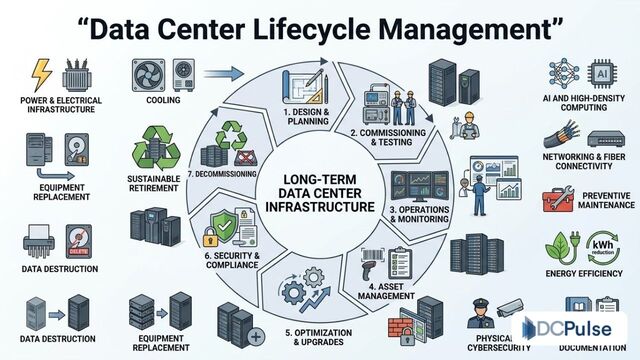
A data center’s operational life is often measured from the moment its servers, storage systems, and network equipment begin handling production workloads. The decisions that shape that operating life, however, are made much earlier. Design choices, equipment selection, commissioning practices, documentation, monitoring architecture, and maintenance planning can all influence how effectively a facility performs after launch.
For data center operators, lifecycle management is therefore becoming a pre-operational discipline rather than a task reserved for an active facility. The approach connects construction and commissioning with the longer-term requirements of availability, capacity expansion, energy management, equipment maintenance, security, and eventual decommissioning.
Lifecycle Planning Begins During Design
The physical and digital architecture established during design creates the foundation for future operations. Electrical distribution, cooling systems, networking, physical security, monitoring, and equipment layouts all have operational consequences once the facility enters service.
Maintainability is particularly important. Equipment that is difficult to access can increase the complexity of routine inspections or replacement work. Electrical and mechanical systems also need sufficient access and isolation arrangements so that maintenance activities can be performed without unnecessarily affecting critical operations.
Future capacity is another consideration. Data centers increasingly need to accommodate changing workload profiles, including cloud services, high-density computing, artificial intelligence, and other demanding applications. A design that considers only the initial deployment may create constraints when additional power, cooling, networking, or rack capacity is required.
Documentation forms another part of the lifecycle foundation. Accurate records of equipment, connections, configurations, warranties, and commissioning results can give operations teams a reliable reference after construction teams leave the site.
Commissioning Is More Than a Pre-Opening Check
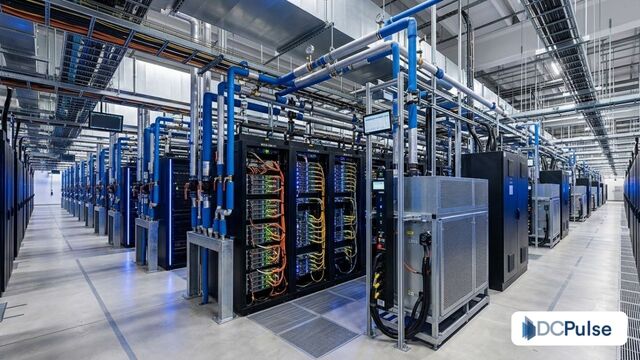
Commissioning provides an important transition between construction and operations. The process can demonstrate whether individual systems and integrated infrastructure perform according to their intended design before production workloads depend on them.
Electrical systems, cooling equipment, backup power, fire protection, building management systems, and network infrastructure may operate differently when tested together than when evaluated independently. Integrated testing can therefore reveal dependencies that may not be obvious from individual equipment tests.
The same principle applies to failure scenarios. Data center resilience depends not only on the presence of redundant components but also on how those components respond to faults, maintenance conditions, and changes in operating states.
A well-documented commissioning process gives operations personnel more than an opening-day assurance. Test results, identified issues, corrective actions, and system configurations can become part of the facility's operational baseline.
Operational Data Should Start With Day One
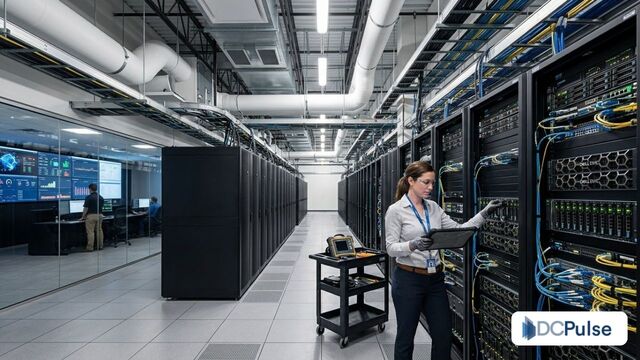
Monitoring architecture is another area where lifecycle thinking begins before go-live. Power consumption, temperature, humidity, cooling performance, equipment status, alarms, and other operational information can provide the foundation for ongoing facility management.
The value of these systems increases when data is organized consistently. Operators need to understand what an alert represents, which asset is affected, what operating conditions are considered normal, and which team is responsible for responding.
Digital infrastructure also creates an expanding operational data layer. Data centers can contain large numbers of sensors, controllers, servers, network devices, power systems, and software platforms. Bringing relevant information together can support troubleshooting and provide a clearer view of facility performance.
Data quality matters alongside data volume. Poorly configured monitoring can produce excessive alerts or incomplete information, making it harder for operators to identify meaningful changes in system behavior.
Asset Management Connects Equipment With Operations
Every major infrastructure component has a lifecycle. Switchgear, generators, UPS systems, chillers, pumps, cooling distribution equipment, network hardware, racks, and IT systems eventually require inspection, servicing, upgrades, replacement, or retirement.
An asset management program can track equipment from installation through operation and eventual disposal. Useful records may include manufacturer information, model numbers, installation dates, service history, warranty information, configuration details, and maintenance requirements.
Such records become particularly important in large or distributed data center portfolios. Multiple facilities may contain similar equipment but have different operating conditions, service histories, or replacement schedules.
Lifecycle records can also support procurement and planning. When equipment approaches the end of its useful service period, operators have an opportunity to evaluate replacement requirements before an urgent failure creates additional operational pressure.
AI and High-Density Computing Add New Lifecycle Requirements
The growth of AI infrastructure is changing the operating environment for data centers. High-density computing can place different demands on power delivery, rack design, cooling infrastructure, and network connectivity compared with more conventional deployments.
Liquid cooling is one example of a technology that can introduce additional lifecycle considerations. The relevant infrastructure may include coolant distribution, heat exchangers, pumps, controls, monitoring systems, and specialized rack-level equipment. Maintenance procedures and operational expertise therefore need to reflect the installed cooling architecture.
Power infrastructure can face similar changes as computing density increases. Capacity planning needs to account for the characteristics of the equipment that will ultimately occupy the facility, rather than treating the initial IT deployment as a permanent configuration.
Lifecycle management provides a framework for adapting to these changes. Infrastructure can be evaluated not simply on whether it works at launch, but on whether it can support changing computing requirements over time.
Energy and Cooling Performance Require Continuous Attention
Energy management is also a lifecycle issue. A facility's efficiency can be affected by equipment condition, operating configurations, workload patterns, ambient conditions, and changes to the IT environment.
Cooling systems require similar attention. A configuration that is appropriate during initial occupancy may need adjustment as rack densities, equipment layouts, and utilization levels change.
Operational teams can use historical data to establish a performance baseline and identify changes that warrant investigation. The objective is not necessarily to maximize a single metric under every condition but to maintain reliable infrastructure while managing energy and cooling requirements in accordance with operational needs.
Networking and Connectivity Have Their Own Lifecycles
The lifecycle of a modern data center extends beyond the building and mechanical infrastructure. Fiber connections, optical equipment, switches, routers, security systems, and interconnection platforms also require planning and periodic upgrades.
Connectivity requirements can change as customers, cloud platforms, AI workloads, and network architectures evolve. Physical pathways and space allocation can influence how easily new connections are introduced.
Carrier diversity and network resilience also depend on infrastructure established during the development stage. Pathways, meet-me rooms, cross-connect arrangements, and documentation can affect future expansion and troubleshooting.
A lifecycle approach treats connectivity as an operational asset rather than a one-time installation.
Security and Compliance Need Continuous Lifecycle Management
Security controls cannot be considered complete simply because a facility passes its initial operational checks. Physical access systems, surveillance, network controls, logging, and procedures require ongoing management.
Changes to equipment, personnel, customers, software, and network architecture can introduce new operational requirements. Documentation and access-control processes therefore need regular review as the facility evolves.
Compliance requirements can similarly affect lifecycle decisions. Records associated with maintenance, testing, access, equipment, and operational procedures may become important for audits or internal governance, depending on the facility and the obligations applicable to it.
Decommissioning Is Part of the Original Lifecycle
The final stage of an asset's life also benefits from early planning. Equipment eventually reaches a point where repair, modernization, or continued operation may no longer be appropriate.
Decommissioning considerations can include data destruction, equipment removal, electrical isolation, environmental handling, asset records, and the reuse or disposal of infrastructure. Planning these processes in advance can reduce uncertainty when equipment reaches retirement.
The same principle applies at the facility level. Data centers may undergo redevelopment, technology transitions, ownership changes, or changes in operational purpose. Lifecycle planning provides a framework for managing these transitions.
From Construction Project to Long-Term Infrastructure
A data center does not become an operational asset only when its first workload goes live. Its lifecycle begins with decisions about architecture, maintainability, documentation, commissioning, monitoring, and future capacity.
For operators and digital infrastructure providers, that perspective changes the role of the construction phase. The objective is not simply to deliver a functioning facility but to establish an infrastructure platform that can be maintained, monitored, upgraded, secured, and eventually retired in a controlled manner.
As data center environments become more complex, lifecycle management can provide continuity between development teams and operations teams. The earlier that operational requirements are incorporated into the facility's design and commissioning process, the more clearly the infrastructure can be prepared for the years that follow its opening.