DCPulse
The cloud remains a central foundation for enterprise computing, but infrastructure requirements are becoming more distributed. AI workloads, real-time applications, data-intensive services, and connected devices increasingly require computing resources closer to users, enterprises, and sources of data.
This shift is changing how organizations think about infrastructure placement. Instead of treating the public cloud as the default destination for every workload, enterprises can use a combination of cloud platforms, neocloud providers, colocation facilities, and edge infrastructure based on workload requirements.
For data center operators, the change creates a more interconnected infrastructure model. Facilities increasingly need to support environments where workloads move between centralized cloud regions, specialized AI infrastructure, private environments, and geographically distributed edge locations.
Why Neocloud Has Become Relevant to Data Center Strategy
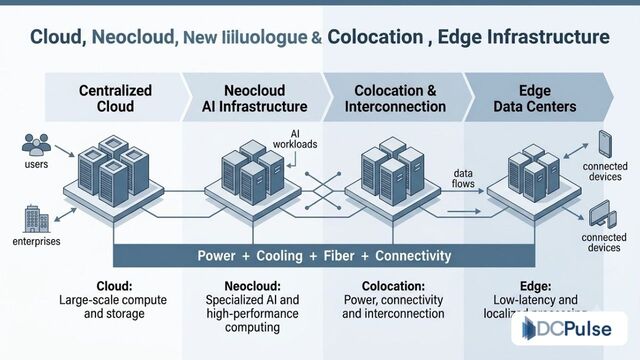
Neocloud providers have emerged around specialized infrastructure requirements, particularly workloads that require high-performance computing, accelerated computing, or dedicated AI resources. Their infrastructure models can differ from the broad, general-purpose services traditionally associated with hyperscale cloud platforms.
The distinction matters for data centers because specialized computing places different demands on physical infrastructure. High-density compute can require greater attention to power delivery, rack density, thermal management, network architecture, and deployment flexibility.
Colocation can provide an important physical layer for these environments. A carrier-neutral or connectivity-rich facility can give specialized cloud providers access to power, networks, interconnection, and enterprise ecosystems without requiring every infrastructure component to be deployed inside a hyperscale cloud campus.
The result is not necessarily a replacement for traditional cloud infrastructure. Instead, the neocloud can become another infrastructure layer within a broader digital architecture.
Edge Colocation Extends the Infrastructure Footprint
Edge colocation addresses a different requirement: proximity. Applications that depend on low latency, localized processing, data sovereignty, or regional availability can require infrastructure closer to end users and data sources than a centralized cloud region can provide.
Edge facilities can range from smaller deployments in regional markets to more substantial colocation environments positioned near network hubs, population centers, industrial clusters, or other sources of digital demand.
The connection between edge colocation and neocloud becomes important when specialized computing needs to operate across multiple geographic locations. A centralized facility can host substantial compute capacity, while edge locations can support workloads that benefit from proximity.
For data center developers, this creates demand for facilities that can participate in distributed architectures rather than operating as isolated buildings.
Connectivity Becomes the Common Layer
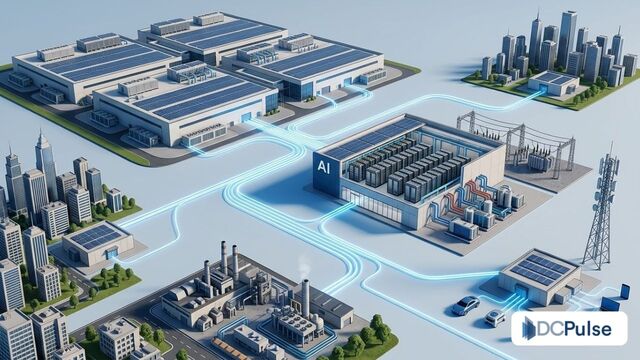
Connectivity is one of the strongest links between cloud, neocloud, and edge infrastructure. Distributed computing depends on reliable movement of data between facilities, cloud platforms, enterprises, networks, and users.
Interconnection-rich colocation facilities can provide access to multiple carriers, internet exchanges, cloud connectivity services, and private network connections. These capabilities can make a facility useful as an infrastructure meeting point even when the primary compute resources are located elsewhere.
For neocloud providers, network access can influence how efficiently specialized infrastructure connects with customers and upstream cloud environments. For edge deployments, connectivity determines how effectively distributed sites communicate with centralized systems and other edge locations.
The data center therefore becomes more than a location for servers. It can function as a connection point within a wider computing architecture.
Power and Cooling Move to the Foreground
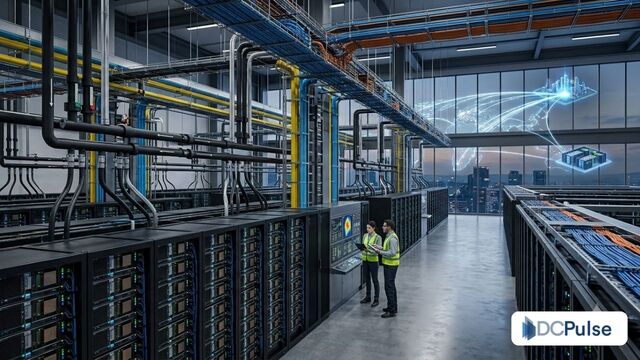
The physical requirements of specialized computing are increasingly important to data center planning. AI and other high-performance workloads can create greater power and thermal management requirements than conventional enterprise deployments.
That dynamic affects both large centralized facilities and smaller distributed sites. High-density deployments require data center operators to evaluate electrical capacity, rack design, cooling architecture, redundancy, and the ability to accommodate changing hardware requirements.
Liquid cooling is one example of how infrastructure design is adapting to higher-density computing, although the appropriate cooling approach depends on workload characteristics, equipment design, facility configuration, and deployment scale.
Edge facilities face additional constraints. Space, power availability, local permitting, operational staffing, and connectivity can differ significantly from conditions at large hyperscale campuses.
A cloud-smart infrastructure strategy therefore requires physical infrastructure that can support different workload profiles without assuming that every site will have identical requirements.
The Data Center Portfolio Becomes More Distributed
The combination of cloud, neocloud, and edge infrastructure can change the role of the data center portfolio itself. Instead of relying primarily on a small number of large facilities, organizations can use multiple infrastructure locations for different operational requirements.
Centralized campuses can support large-scale computing and storage. Colocation facilities can provide interconnection and access to multiple infrastructure providers. Edge sites can place selected workloads closer to users and data sources.
This architecture can also create new requirements for data center operators. Facilities may need flexible deployment models, diverse connectivity, scalable power, and operational capabilities suited to different customer types.
The commercial model can evolve alongside the technical model. A facility serving enterprises, cloud on-ramps, neocloud platforms, network providers, and edge deployments can become part of several infrastructure ecosystems simultaneously.
Cloud-Smart Does Not Mean Cloud-Avoidant
The move toward cloud-smart infrastructure should not be interpreted as a broad retreat from public cloud. Cloud platforms continue to provide extensive computing, storage, networking, managed services, and global infrastructure.
The central change is workload placement. Organizations can determine where a workload should run based on factors such as performance requirements, latency, connectivity, security architecture, data location, cost structure, and operational needs.
Some workloads may remain entirely within public cloud environments. Others may use specialized neocloud infrastructure, dedicated enterprise environments, or colocation facilities. Edge deployments can complement these environments where geographic proximity is important.
For data center operators, this creates an opportunity to position facilities as enabling infrastructure for workload diversity rather than competing directly with cloud platforms.
Implications for Data Center Developers
Data center development strategies are increasingly influenced by the requirements of different computing models. Location remains important, but it is only one part of the infrastructure equation.
Power availability can determine whether a site can support high-density deployments. Fiber availability and carrier diversity can influence connectivity. Access to cloud ecosystems can affect enterprise adoption. Cooling capabilities can determine the practicality of specialized computing.
Site selection therefore requires a broader assessment of the digital infrastructure ecosystem. A facility with strong power and connectivity characteristics can support multiple infrastructure models, while a site with limited network access may face constraints even when other physical conditions are favorable.
For edge development, the equation becomes more localized. Proximity to users and network infrastructure can become more important than access to large-scale campus land.
A More Layered Digital Infrastructure Model
The relationship between neocloud and edge colocation reflects a broader transition in digital infrastructure. Computing is becoming more specialized and geographically distributed, while applications increasingly depend on connectivity between multiple infrastructure environments.
For data centers, the implication is a more layered operating model. Large campuses, colocation facilities, specialized computing environments, and edge sites can perform different functions while remaining interconnected through networks.
The cloud remains a critical part of this architecture, but infrastructure decisions are increasingly based on where computing delivers the required performance and operational characteristics.
A cloud-smart approach consequently places greater emphasis on interoperability. Data centers that can connect customers to diverse compute environments, networks, and infrastructure providers can play a central role in this emerging model.
The long-term direction of the market will depend on workload requirements, power availability, network development, AI infrastructure deployment, and enterprise architecture decisions. What is becoming clearer for data center planning is that centralized cloud capacity and distributed infrastructure are not necessarily competing models. They can form complementary layers of the same digital infrastructure ecosystem.